Akaka Falls, Volcanoes & Hilo day (full hour at the falls)
7 to 8 hours
from $179per person, varies by date Check availability →Paved does not mean flat. Here is the honest mobility picture from a guide who has walked every kind of group through.
 Verified by Kekoa Kalani, Akaka Falls tour guide and island nature specialist
Short answer
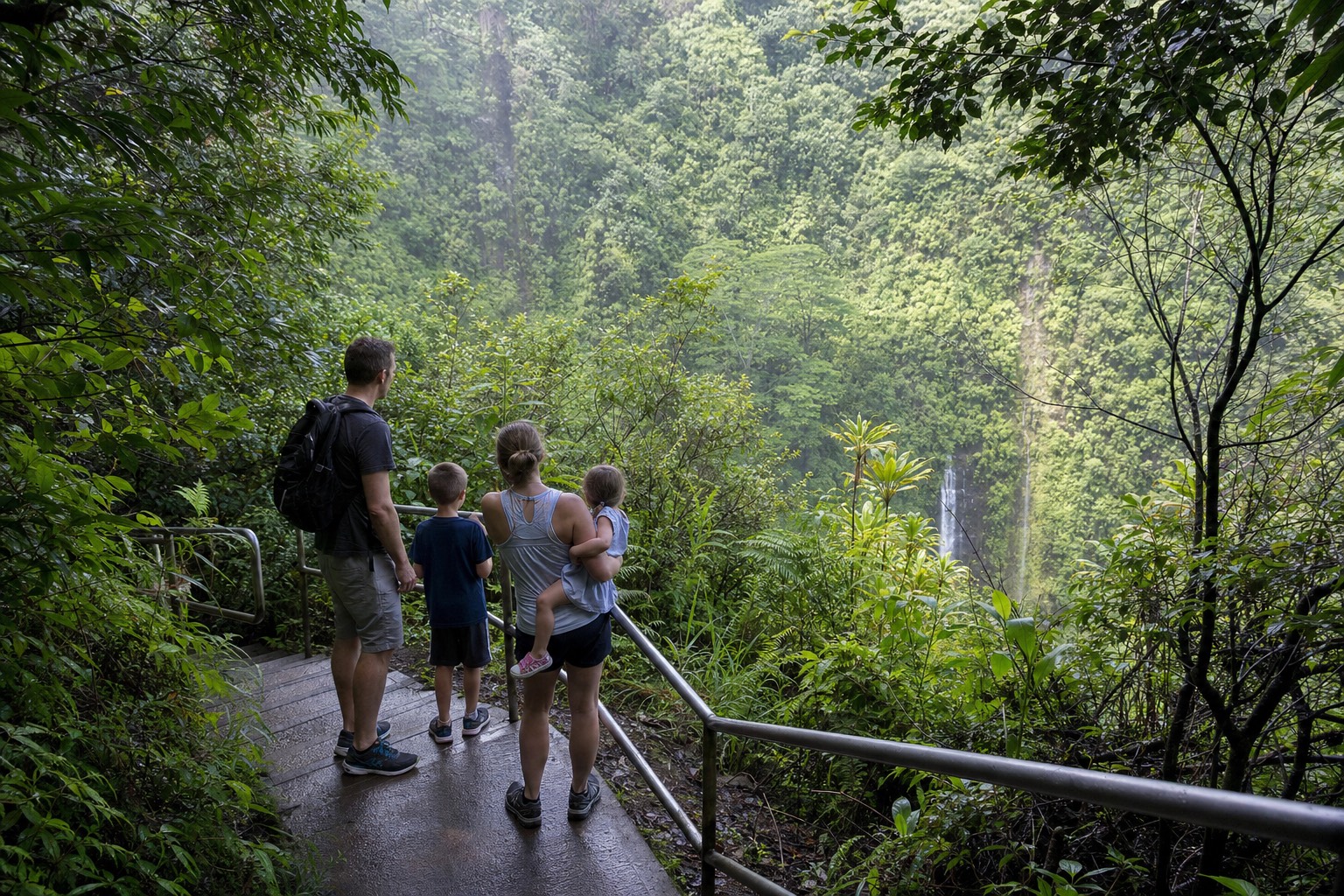
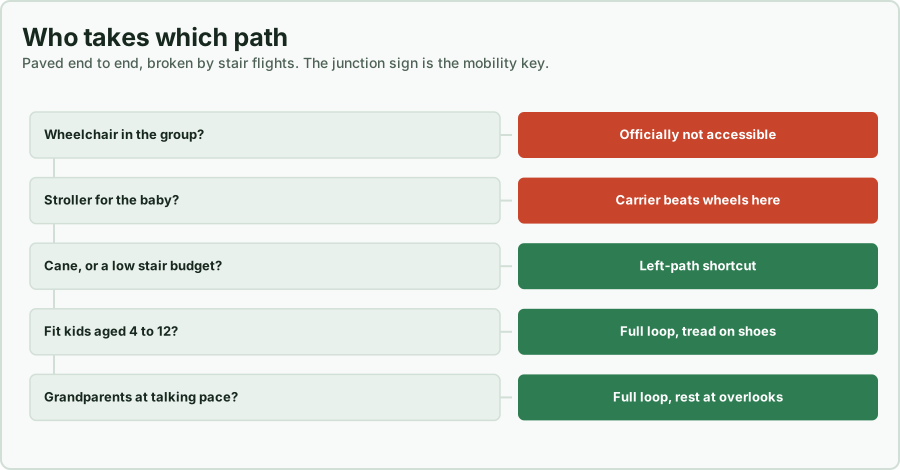
The loop is fully paved but broken by multiple stair flights, and the state officially classes it as not wheelchair accessible. Fit kids love it, strollers struggle, and slow walkers can use the left-hand shortcut to see only ʻAkaka Falls. Children 3 and under enter free, and the fee kiosks take credit cards only.
The first sound at the trailhead is never the waterfall. It is the parking lot: car doors, a stroller snapping open, somebody asking in a low voice whether Grandma should just wait in the vehicle. I have heard that conversation more times than I can count, and it almost always ends the same way, with Grandma walking and the stroller back in the trunk.
The question grandparents ask me is rarely about the waterfall. It is some careful version of "will I embarrass myself out there?" After a decade of walking three-generation families around this loop, my answer is usually no, with one honest asterisk about stairs. ʻAkaka Falls is kinder than most Big Island trails to mixed-ability groups and harder than its photos suggest.
The whole 0.4-mile loop is paved, and the state still describes it as a trail that requires some physical exertion, and classes it as not wheelchair accessible. Pavement is not the same as flat. Stair flights break the circuit in several places, and that one fact decides who has an easy morning here.
The official DLNR park page does not hedge. The loop trail requires some physical exertion, there are steps in places, and the park is not wheelchair accessible. The pavement fools people badly. From the lot the path reads as a garden promenade, smooth and edged and wide enough for two abreast. Then it tips into the gulch, meets its first flight of steps, and the illusion is over.
What confuses visitors is that "paved" and "accessible" get used as if they mean the same thing. Here they do not. The paving exists because this is old rainforest ground inside a 65.4-acre park that catches Hamakua Coast rainfall of nearly 84 inches a year. Without the concrete this would be a mud chute by February. It is a surface decision, not a gradient decision. Between the flights the trail also tilts, sometimes for twenty or thirty yards at a stretch, and those slopes ask more of a tired knee than the steps do.
The good news is the scale. Four tenths of a mile is a short walk, and the effort arrives in small instalments rather than one lung-emptying push. I have taken visitors round this loop who told me flatly at the gate that they could not do it. Almost all of them did. The ones who struggled were not the oldest; they were the ones who started fast.
Here is how the loop actually treats each kind of visitor, based on walking it with all of them.
| Visitor | How the loop treats them | My advice |
|---|---|---|
| Kids 4 to 12 | Brilliantly, the stairs are the fun part | Real tread on their shoes, one hand near every rail |
| Babies and toddlers | Fine, as long as they are carried | Chest or back carrier, leave the wheels behind |
| Stroller families | Multiple stair flights stop wheels dead | Carrier, or one adult stays near the trailhead |
| Fit seniors | Very doable at talking pace | Take the rail, use every overlook as a breather |
| Cane users, healing knees | Hard on the full circuit | Take the left-hand shortcut and go slowly |
| Wheelchair users | Officially not accessible | The falls stay out of reach, so weigh the fee first |
No, not on wheels. Strollers work only if you are willing to carry them loaded up and down several stair flights, which nobody enjoys in that humidity. Wheelchairs cannot complete the circuit at all, and there is no alternate ramped route to the main overlook. A carrier solves the stroller problem entirely.
I have watched the stroller decision play out hundreds of times and it resolves the same way every time. A family unloads the stroller, gets maybe forty yards, hits the first descent, and then one parent is walking backwards down concrete steps holding the front axle while the other steadies the back. Two flights later the child is on a hip and the stroller is parked against a railing near the entrance for the rest of the visit. Skip the middle act. Bring a chest carrier for infants or a framed back carrier for a heavier toddler, and the trail becomes an ordinary walk with a warm passenger.
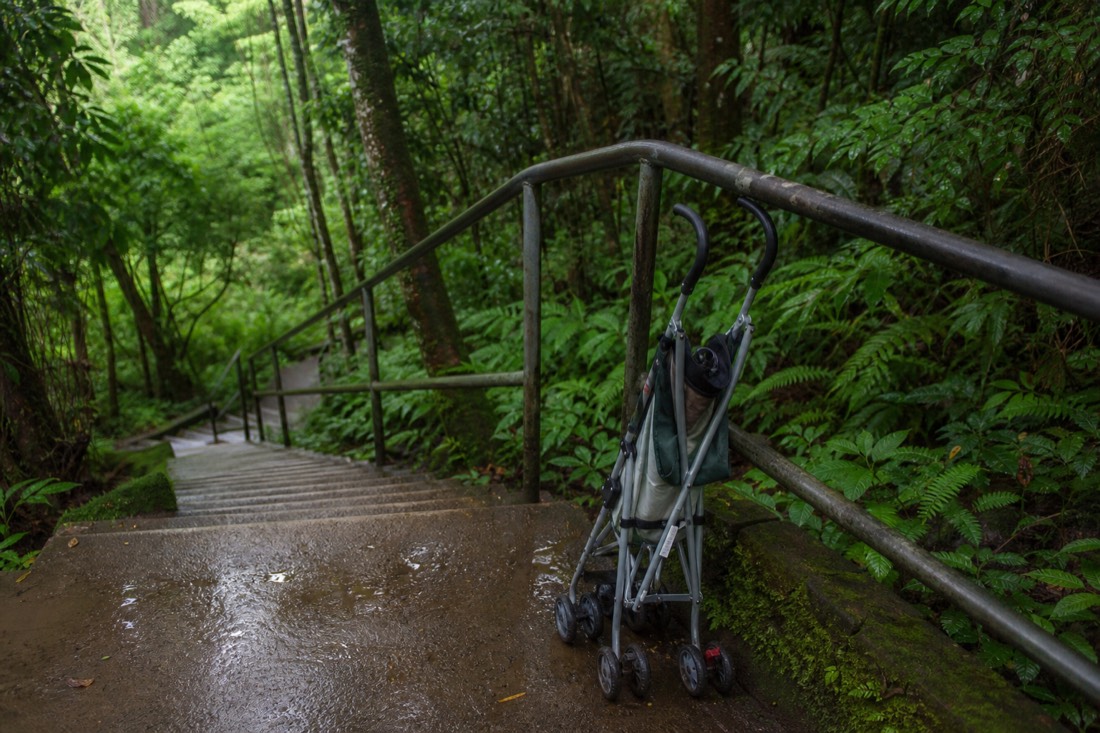
For wheelchair users the honest answer is harder and I am not going to dress it up. The park charges before you see the trail, and the trail does not open up further in. There is a paved area near the entrance where you can sit under the canopy and hear the gulch, but the 442-foot fall itself is earned on foot down steps. Decide at the kiosk whether that entrance area alone is worth the fee for that person. Plenty of families pay for the walkers only and rotate someone out to sit, and that is a reasonable call.
There is a better alternative for that visitor, back down the coast in Hilo. Rainbow Falls is seen from close to its parking area, and I explain the trade in Rainbow Falls compared with ʻAkaka Falls. Pair the two: walkers do ʻAkaka, everyone sees Rainbow.
This table is the audit I run in my head when a family arrives with equipment.
| What you brought | Where it stops working | What that person still reaches | My honest call |
|---|---|---|---|
| Umbrella stroller | The first stair flight | Trailhead and entrance area | Leave it in the car |
| Framed back carrier | Nowhere, it goes the whole way | The full loop | The best tool for the job |
| Chest carrier | Nowhere | The full loop | Ideal under about a year old |
| Cane | Slows you, does not stop you | The main overlook via the shortcut | Take it, take your time |
| Walker or rollator | The first flight | Entrance area only | Not a loop trail aid |
| Manual or powered wheelchair | The first flight | Entrance area only | Weigh the fee before paying |
At the first junction past the entrance, the left-hand south path runs straight to the ʻAkaka Falls overlook and back. It is the park's own published route for people who want the main waterfall and nothing else. It cuts distance and the deepest stair sections, though it is not stair-free and never claims to be.
This is the most useful sentence on the official page, and half the visitors walk past the junction without reading it. For someone with a cane, a healing ankle, or simply a limited stair budget, it changes the whole calculation. Less distance, fewer flights, and the reward is the same view of the same 442-foot column of water the full-loop walkers spend twice as long earning.
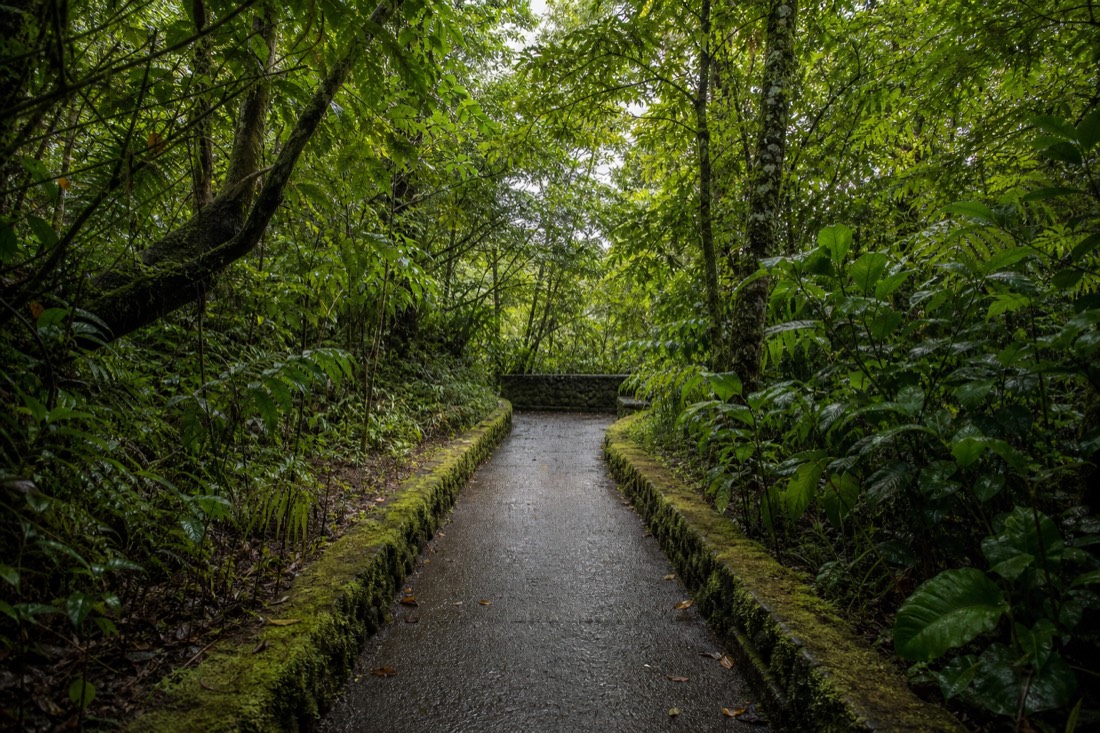
What you give up is Kahuna Falls and the bamboo, and I want to be straight about that rather than pretend the shortcut is a free lunch. Kahuna is the quieter cascade on the far side, glimpsed through vegetation rather than presented on a platform, and the walk to it passes the loveliest planted stretches in the park. If your knees are fine, walk the whole thing. The full loop trail guide covers what you see in each direction.
My standard play with a mixed group is to split at that junction. Teenagers and steady walkers go right for the full circuit past Kahuna; the slower party goes left and reaches the main overlook first, having done less work. Everyone meets at the same railing, and nobody has spent the morning being waited for or towed along. The reunion timing works out close to even, which still surprises people.
Here is the direct comparison I give at the junction.
| Full loop | Left-hand shortcut | |
|---|---|---|
| Distance | The complete 0.4-mile circuit | A shorter out-and-back |
| Stair load | Several flights, down and back up | Reduced, not eliminated |
| Waterfalls seen | Kahuna Falls and ʻAkaka Falls | ʻAkaka Falls only |
| Time at a slow pace | 45 to 60 minutes | Roughly half that |
| Best for | Anyone whose knees are cooperating | Canes, low stamina, rationed steps |
Manageable in short doses. The steps come as separate flights spread around the circuit rather than one long staircase, every flight has a rail or a solid edge to steady on, and the whole walk is only 0.4 miles. Most slower visitors finish in 30 to 45 minutes including proper rest stops.
The rhythm is what rescues this trail. You drop a flight, you walk a flat or gently graded stretch through dripping rainforest, then you meet the next flight. Nobody stands at the bottom of a tower of steps looking up at all of it, which is the thing that defeats people psychologically on other trails. The overlooks arrive at useful intervals and give everyone a socially acceptable reason to stand still and breathe without admitting they need to.
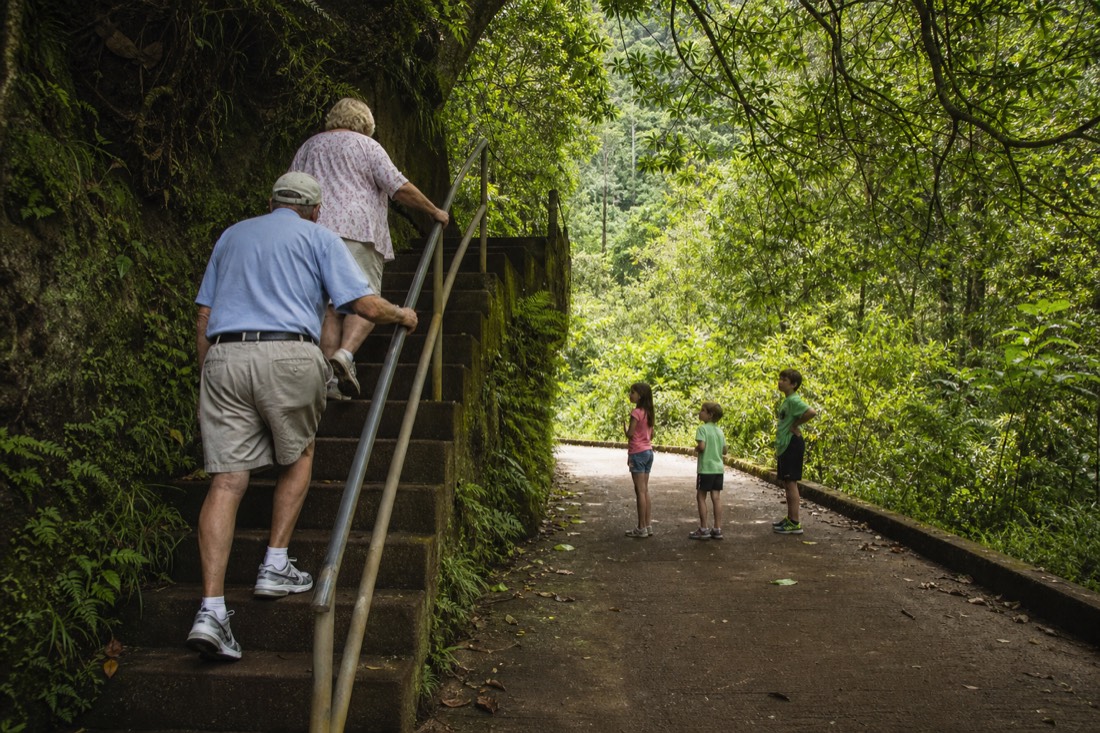
Two honest cautions, and they are the two I repeat at every trailhead briefing. First, the pavement under that canopy stays damp most of the year, so the real hazard for a four-year-old and a seventy-eight-year-old is identical: slipping, not tiring. Proper tread on every pair of feet in your group is the single best safety decision you will make all day, and it costs nothing. Smooth-soled sandals and this trail are a bad pairing. On a wet morning I get even more insistent, for reasons I lay out in what rain does to the falls.
Second, the climb back to the parking lot lands at the very end, exactly when small legs and older knees have run out of opinions. People underestimate that final ascent because they budgeted for the descent and forgot the gulch has to be paid back. Keep water in a pocket, not in the car. If you want a realistic time budget for your crew, how long you actually need at the park breaks it down by pace.
Heat is the quieter factor. Mornings are cooler, quieter and easier on everyone, which is exactly why I steer my gentlest groups into the first hour, and the reasoning sits in the best time to visit ʻAkaka Falls. If a guided day is on your list for a mixed-ability group, you can see which mornings are open before you commit to a rental car and a parking hunt.
The stairs, mostly. Adults see an obstacle and kids see a climbing frame with a waterfall at the end. Add the noise of the gorge, leaves bigger than they are, and one genuinely startling drop into the ravine, and the whole loop lands neatly inside a young child's natural attention span.
I stopped apologising to parents about the stairs years ago, because the children kept correcting me. Six-year-olds count the steps out loud. Four-year-olds want to do a flight twice. The concrete has a satisfying echo under small shoes, and the rails give them something to hold, which is the habit you want them building anyway. Moving children are happy children, which is more than you can say for a scenic pullout where everyone stays belted in.
The plants do a lot of work too. Philodendron leaves here grow wider than a toddler is tall, ginger crowds the trail edges, and bamboo groans overhead when the trade wind moves through. Strange is the thing children remember. Then the gorge delivers the real reaction: you come around to the railing, the ground simply stops, and the water is falling further than anything they have seen fall.
Expect questions about swimming, because every child asks. The answer is no, and it is not a negotiation: this is a fenced viewing trail above a stream-eroded gorge with no water access at all. Why you cannot swim at ʻAkaka Falls gives you the version to read out loud before you arrive, which works much better than improvising it at the railing with a disappointed eight-year-old.
Thirty to forty-five minutes is not a compromise for a young family, it is the sweet spot. Long enough to feel like an adventure, short enough that nobody melts down at the far end of a loop with no exit. That is also the argument for keeping the whole guided day short with young children: if a full volcano itinerary is more than your crew has in them, the shorter waterfall morning gets everyone home before the afternoon falls apart. Here is what each age tends to latch onto.
| Age | What actually grabs them | How long it holds |
|---|---|---|
| Under 3 | The sound and the green ceiling overhead | The whole walk, if carried |
| 3 to 5 | Counting steps, gripping the rail | 20 to 30 minutes before the wobble |
| 6 to 9 | The drop into the gorge, the giant leaves | The full loop, easily |
| 10 to 13 | The height of the fall, taking their own photos | Full loop plus a second look |
| Teenagers | The overlook, then their phone | Shorter than you think, and there is no signal |
Museum speed. Set a pace that lets everyone talk in full sentences the entire way, stop at every overlook whether anyone needs it or not, and treat the humid air as part of the workload. Give the main overlook real time. Rushed, this trail is unpleasant. Unhurried, it is a gentle morning.
Pace is the whole game with older visitors, and I set it from the first ten steps rather than letting the group find its own speed. The instinct is to walk at the rate of the fastest person and pretend everyone is fine, which leaves the slowest walker permanently behind, apologising and out of breath. Instead I walk at the front, slowly, and let the group pile up behind me. Nobody is holding things up if the guide is setting a deliberate crawl.
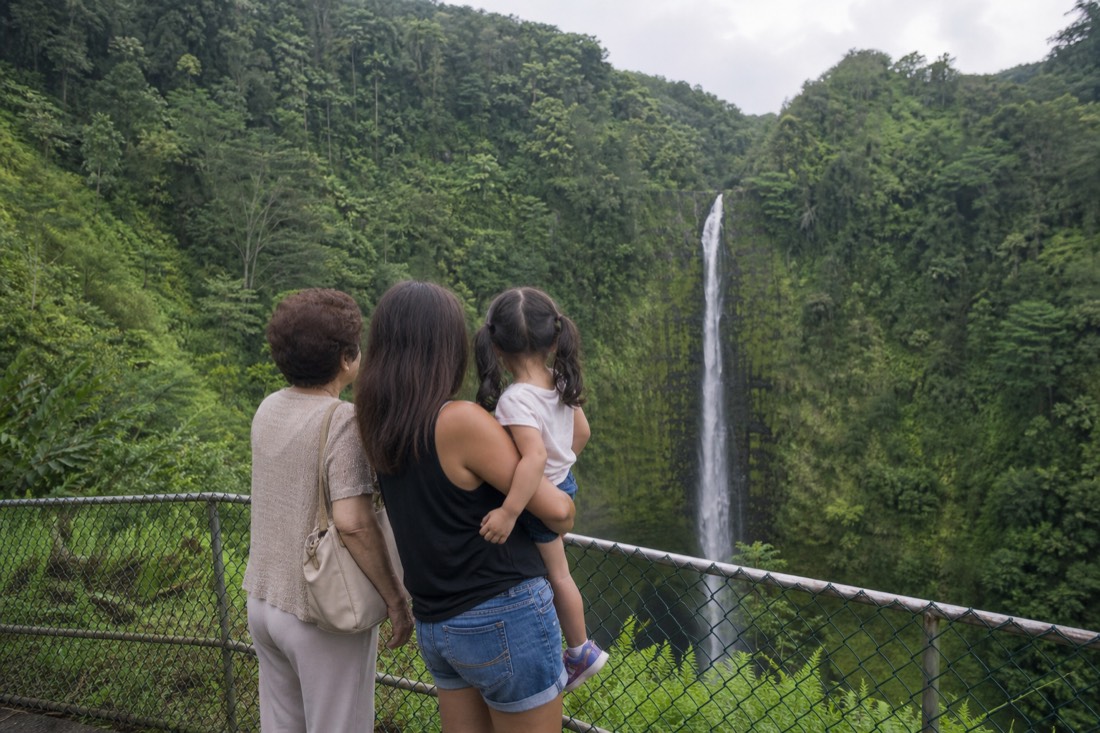
The humidity catches mainland visitors more than the gradient does. Air on this coast is thick and warm even at eight in the morning, and someone used to dry indoor air will feel their breathing change on the return climb before their legs complain. That is normal, and not a reason to stop. It is a reason to break the ascent into two or three unhurried pushes with a real pause between each. Talking while climbing is what actually empties people.
Give the main overlook longer than feels necessary. That railing is where the whole trip pays off, and an older visitor who has just worked for the view deserves to stand there until they are done rather than until the group is. Five minutes at that rail beats a hurried photo every time, and the light shifts constantly in the gorge, which the photography guide covers properly.
Pacing starts before the trail, on the road. From Kona it is around ninety minutes each way, a long stretch of winding coast either side of the walk, and the Kona-side drive guide is honest about what that costs an older passenger. From Hilo it is about eleven miles and a much easier day.
At the overlooks and on the flatter contour stretches between stair flights. The trail supplies stopping places roughly where you want them, and the good ones are wide enough to stand out of the walking line. The real skill is stepping aside properly rather than stopping in a bottleneck.
The trail is not generous with width everywhere, so where you rest matters as much as when. Stopping mid-flight forces everyone behind you into an awkward squeeze past on damp concrete, which is the exact situation that produces a slip. Walk the extra ten seconds to the top or bottom landing, move to the inside edge away from the drop, then take as long as you like.
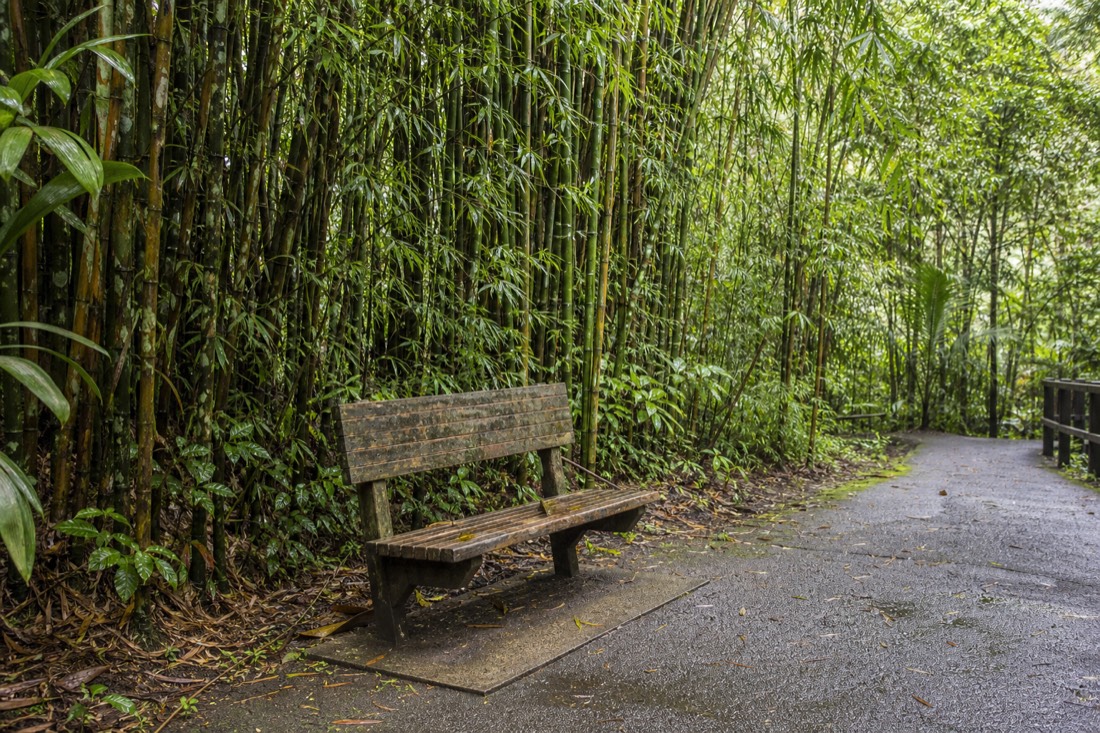
The overlooks are the ones to plan around, because they give you a rail to lean on, a reason to be standing still, and something worth looking at while your breathing settles. There is seating in the park here and there, but I never promise a group a specific bench, since at busy midday it may well be occupied. Plan around the railings and landings, which are always there, and treat a free bench as a bonus.
The contour stretches between the flights are underrated. Level or nearly so, shaded, quiet enough that most of the conversation on my walks happens there. If someone in your group is struggling, this is the ground to slow down on, not the stairs.
These are the places I actually use, in the order you meet them.
| Rest point | What it gives you | Footing note |
|---|---|---|
| The first junction | Level ground, a decision point, room to regroup | Widest spot on the trail |
| Landings at the top and bottom of flights | Somewhere to stand out of the walking line | Damp, stay off the tread edge |
| The Kahuna Falls viewpoint | A rail, a view, an unhurried excuse to stop | Full-loop walkers only |
| The bamboo and contour stretches | Shade, level walking, quiet | The most comfortable ground in the park |
| The main ʻAkaka Falls overlook | The payoff, a solid rail, real breathing room | Can get crowded midday |
| The final ascent landings | Splits the climb into manageable pushes | Where tired legs make mistakes |
The gorge side is fenced where you stand and look, and the drop is not the real hazard here. Wet pavement is. My one rule for children is simple and I never negotiate it: one hand stays on the rail on every staircase, going down and coming back up.
Parents arrive worried about the height, which is the wrong thing to worry about. The viewing areas are fenced, the fencing is there precisely because a 442-foot gorge is behind it, and a child at the railing looking through it is doing what the railing was built for. What I watch for is different: kids running a downhill flight, adults reading a phone on wet steps, anyone treating a rail as furniture.
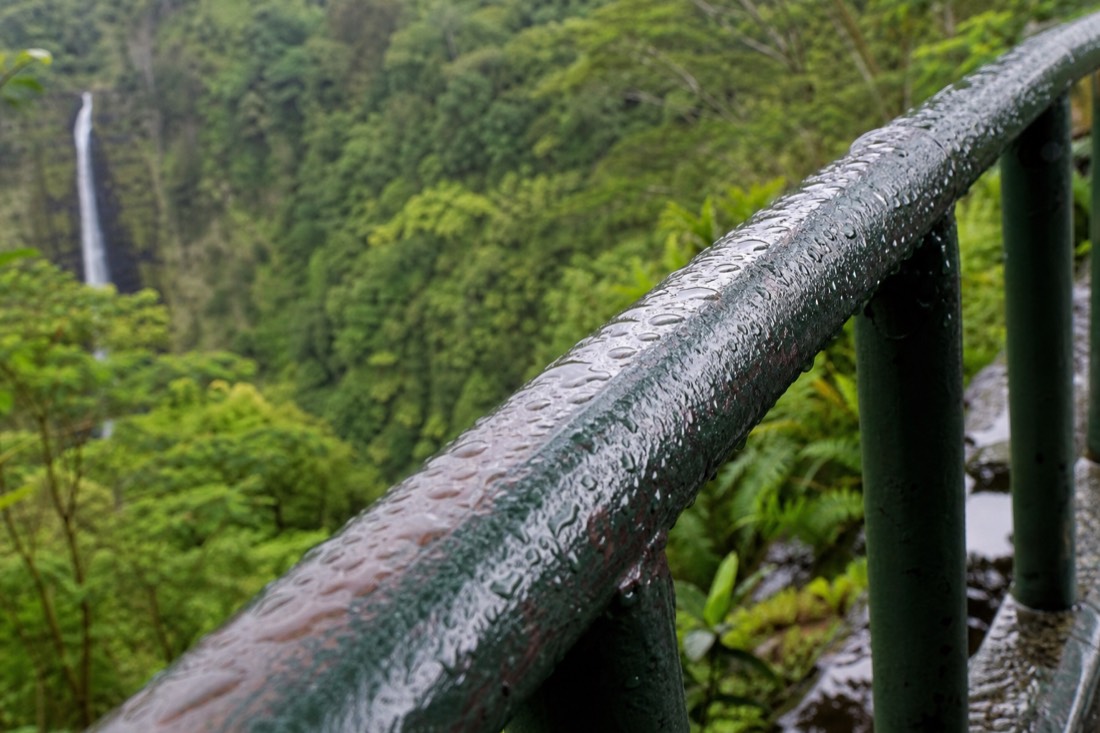
So, three things I say out loud before we start. Do not sit on a railing or lean back against one, ever, with a camera or without. Do not climb onto the lower bar to see better, because the better view is a step to your left anyway. And stay on the trail: the park is explicit about that, there is no mountain biking and no shortcutting through the vegetation, and off-trail ground here is steep, undercut and slick in a way that pavement completely disguises.
The one-hand rule does more work than any other instruction I give. It slows children to a sensible speed without making them feel supervised, and it turns a staircase into a task with a rhythm instead of a race. Older kids roll their eyes and comply anyway. Adults with careful knees should follow the same rule, and I include myself on a rainy morning.
Rain is the honest safety variable. Nearly 84 inches a year falls along this coast, and the trail is often damp under the canopy even when the sky is clear. That is why footwear matters more than fitness here, and it is one of the points I make in what I wish visitors knew about this park.
Three things. The kiosks take credit cards only, with no cash accepted anywhere. Children 3 and under enter free. Cell reception at the park is poor enough that the state encourages you to pay before you arrive. Non-residents pay $5 per person plus $10 to park; residents are free with ID.
The card-only rule catches cash-ready families every week, and it makes a miserable start to a morning. No coin slot, no attendant with a cash box, no talking your way past it. Just card readers, which depend on a signal this gulch is not good at providing. That is why the state pushes you toward the official state parks portal before you set out. Handle the fee on hotel wifi over breakfast and the kiosk becomes something you walk past.
The park itself is the cheap part of a family day out, which surprises people who have just paid for a rental car. Nobody under four costs anything at the gate. There is no timed entry to fight for either, no booking window, no reservation queue: you show up inside the daily 8:30am to 5:00pm window and you walk in. For where the rest of a waterfall day's money goes, what a Big Island waterfall day really costs does the full arithmetic, and the park cost breakdown covers the fee structure on its own.
Getting there is straightforward and worth knowing before you lose signal: the park sits at the end of ʻAkaka Falls Road, Highway 220, about 3.6 miles southwest of Honomū, roughly eleven miles from Hilo and about ninety minutes from the Kona side. Honomū itself is a good pre-trail stop for a bathroom break and something sweet for the kids.
Here is the arithmetic for the most common family shapes, non-resident rates.
| Who is in the car | Entrance | Parking | Total at the gate |
|---|---|---|---|
| Two adults | $10 | $10 | $20 |
| Two adults, one child over 3 | $15 | $10 | $25 |
| Two adults, two children over 3 | $20 | $10 | $30 |
| Two adults, two children, one toddler under 3 | $20 | $10 | $30 |
| Two adults, four children over 3 | $30 | $10 | $40 |
| Hawaii residents with driver's licence or ID | Free | Free | Free |
Because a family separates and a phone is the tool everyone assumes will fix that. Reception at the park is poor, messages sit unsent inside the gulch, and the loop has two ways round. Agree on a physical meeting point before you walk in, and download your map before you leave town.
This is the practical detail I care most about with families, and the one nobody plans for. Groups split naturally here: teenagers surge ahead, one parent hangs back with a slow toddler, somebody stops for a photo and looks up to an empty trail. Normally that resolves with a text. Here the text sits in the outbox and two halves of a family circle the same 0.4-mile loop in opposite directions with rising irritation.
My rule with every group, kids or no kids, is a fixed physical rendezvous: nobody leaves the main ʻAkaka Falls overlook until everyone has been there. It is unmistakable, it is where everybody is going anyway, and it removes the phone from the equation. Say it in the parking lot, before anyone has headphones in, and repeat it at the junction.
Two smaller pieces of the same problem. Download your offline map before you leave Hilo or Waikoloa, because the coast has patchy service well before the park gate and Highway 220 is not the road to be guessing on. And the kiosk shares your signal problem, so a card that works anywhere else can fail here through no fault of the card. Paying online first removes both headaches.
There is a version of this that hits cruise passengers hardest, since a missed rendezvous eats directly into an all-aboard deadline. I walk through the timings in the Hilo cruise port run to the falls, and if your window is genuinely tight, a driver who owns the clock is worth more than the fare. You can look at what the Hilo-side day includes and judge it against your own schedule.
The small-group ones, because vehicle caps of 13 and 14 keep the pace human. A small van waits for a slow walker in a way a full coach never does. The Hilo-side day is the standout for gentle pacing: it gives a full hour at the falls instead of a rushed stop.
Self-driving is still the cheapest option and I am not going to pretend otherwise. Where a guided day earns its keep for this audience is energy management, not sightseeing. Pickup instead of a parking hunt. Admissions handled while you handle the children. Someone else absorbing the wrong turn in Honomū and the car-seat wrangling. I watch the difference weekly: the self-drive family reaches the trailhead already spent, the van family steps out fresh.
Time at the falls is the number I would actually compare, because it decides whether your morning feels calm or clipped. Thirty-five minutes is enough for a fit group doing the full loop briskly. It is not enough for museum speed with a grandparent and a five-year-old. The full hour absorbs the slow pace, the extra stops and the second look at the overlook without anybody checking a watch.
| Option | Pickup side | Time at the falls | Group cap | What it gives a family |
|---|---|---|---|---|
| Hilo day with the volcano | Hilo | A full hour | 14 | The gentlest pacing, and the longest stop of any option here |
| The same operator's other Hilo day | Hilo | A falls-focused stop | Small group | Adds Rainbow Falls and the Onomea scenic drive |
| Circle island in one day | Kona and Waikoloa | About 35 minutes | 13 | Enormous value, but a long day for small children |
| Half-day waterfall circuit | Hilo | A shorter falls-first visit | Small group | Fits a cruise morning or a short window |
| Waterfall day from Kona | Kona and Kohala | About 40 minutes | Small group | Waterfall-led, solves the resort-side drive |
That full hour is the detail I keep steering grandparents toward, and the Hilo-based falls and volcano day is the one built around it. If that is your shape of trip, check price and availability for your dates before the good mornings go.
Bring the grandparents and bring the four-year-old. Leave the stroller in the trunk, put real tread on every pair of feet, use the junction sign the way the park intended, and pay online before you leave town. Then walk it at whatever speed the slowest person sets.
The families who have a bad morning here almost always made the same two mistakes: they arrived on wheels and they arrived in a hurry. Neither is about age or fitness. I have watched an eighty-year-old on a cane reach that overlook in fine spirits while athletic thirty-somethings arrived frazzled, having squeezed the falls into a forty-minute slot between two other stops. The trail does not reward efficiency.
One last thing worth saying to the grandparent reading this and quietly worrying. Nobody at that railing knows or cares how long you took to get there, whether you took the shortcut, or how many times you stopped. What they see is the same waterfall you see. I have never once had a slow walker reach that overlook and tell me it was not worth it. Not one, in a decade, out of well over a thousand travellers.
7 to 8 hours
from $179per person, varies by date Check availability →Half day
from $229.99per person, varies by date Check availability →About 11 hours
from $276per person, varies by date Check availability →