The Akaka Falls Hike: What the 0.4-Mile Loop Is Really Like
Short, paved, and steeper in places than the mileage suggests. Here is the honest walk-through.
 Verified by Kekoa Kalani, Akaka Falls tour guide and island nature specialist
Short answer
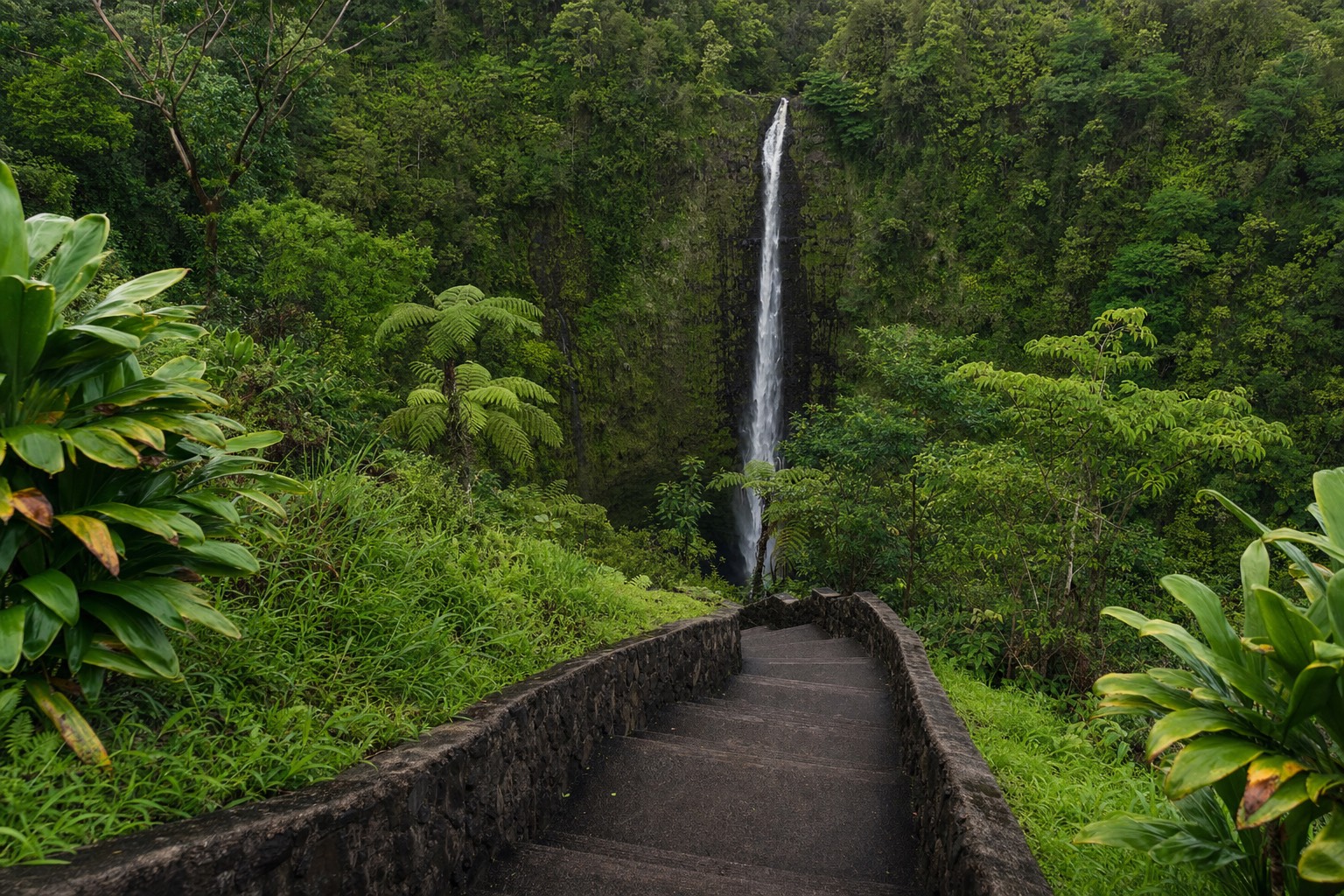
The ʻAkaka Falls hike is a 0.4-mile paved loop with multiple flights of stairs, officially rated as requiring some physical exertion and not wheelchair accessible. Most visitors finish in 30 to 45 minutes. It passes cascading Kahuna Falls first, then the main 442-foot ʻAkaka Falls overlook. A left-hand shortcut skips straight to ʻAkaka Falls.
The first thing guests say at the trailhead is some version of "that's it?" A 0.4-mile loop sounds like a stroll to the mailbox, and the sign at the gate does nothing to talk them out of that. Then we hit the first stair flight dropping into the gulch, the air goes thick and green, and by the climb back out most people have quietly revised their opinion of Hawaii's shortest famous hike. I have walked this loop more times than I can count since 2015, in blazing morning sun and in rain heavy enough to make the handrails cold, and it still earns respect out of all proportion to its length. Nothing here is hard in the mountaineering sense. It is just that a short walk with stairs at both ends, wrapped in air that never fully dries out, is not the same animal as a short walk on flat ground.
How long is the ʻAkaka Falls hike, really?
The loop is 0.4 miles of paved footpath and most visitors finish in 30 to 45 minutes at a relaxed pace with photo stops. Photographers and slow walkers stretch it toward an hour. The distance is short. The stairs, the stopping and the humidity are what set your actual time on the trail.
The official DLNR park page lists the ʻAkaka Falls Loop Trail at 0.4 miles, and that figure is honest. What the mileage hides is the shape of the walk. The trail drops into a stream gulch, contours along the hillside past the Kahuna Falls viewpoint, climbs toward the main ʻAkaka Falls overlook, then climbs again to close the loop back at the parking lot. You are rarely on flat ground for more than a dozen paces. That constant up and down is why a distance you could cover in seven minutes on a sidewalk eats half an hour here.
Here are the trail facts in one place, the ones I get asked about at the gate before anyone has taken a step.
| Trail fact | Detail |
|---|---|
| Distance | 0.4-mile loop |
| Surface | Fully paved footpath with stair sections |
| Official difficulty note | "Requires some physical exertion" |
| Wheelchair accessible | No, per the official park page |
| Typical time on the loop | 30 to 45 minutes |
| Unhurried pace with photography | 50 to 60 minutes |
| Waterfalls seen | Kahuna Falls (cascading) and ʻAkaka Falls (442-foot free fall) |
| Park hours | Daily 8:30am to 5:00pm |
| Park size | 65.4 acres |
Two things stretch that window in practice. The first is crowding at the main overlook, where the rail holds maybe a dozen people comfortably and a tour bus arrival can cost you ten minutes of waiting for a clear frame. The second is simply that people stop moving once they see the falls. I have watched guests plan on twenty minutes and stand at that rail for fifteen of them. If you want the full arithmetic of a park visit rather than just the walking, including the parking, the pay kiosk and the walk back to the car, I broke it down in how much time you need at ʻAkaka Falls.
The other honest answer is that the hike is almost never the long part of your day. From Hilo it is roughly 11 miles up the coast, so the walk and the drive are near enough the same length. From Kona it is about 90 minutes each way, which means the driving outweighs the hiking by a factor of four before you have paid a single fee. Kona-side visitors who would rather not spend three hours behind the wheel for a 40-minute walk can check dates and current pricing on the waterfall day that starts on the resort coast and handles the whole drive. The route itself, if you are driving, is covered in Kona to ʻAkaka Falls.
How hard is the loop on real legs?
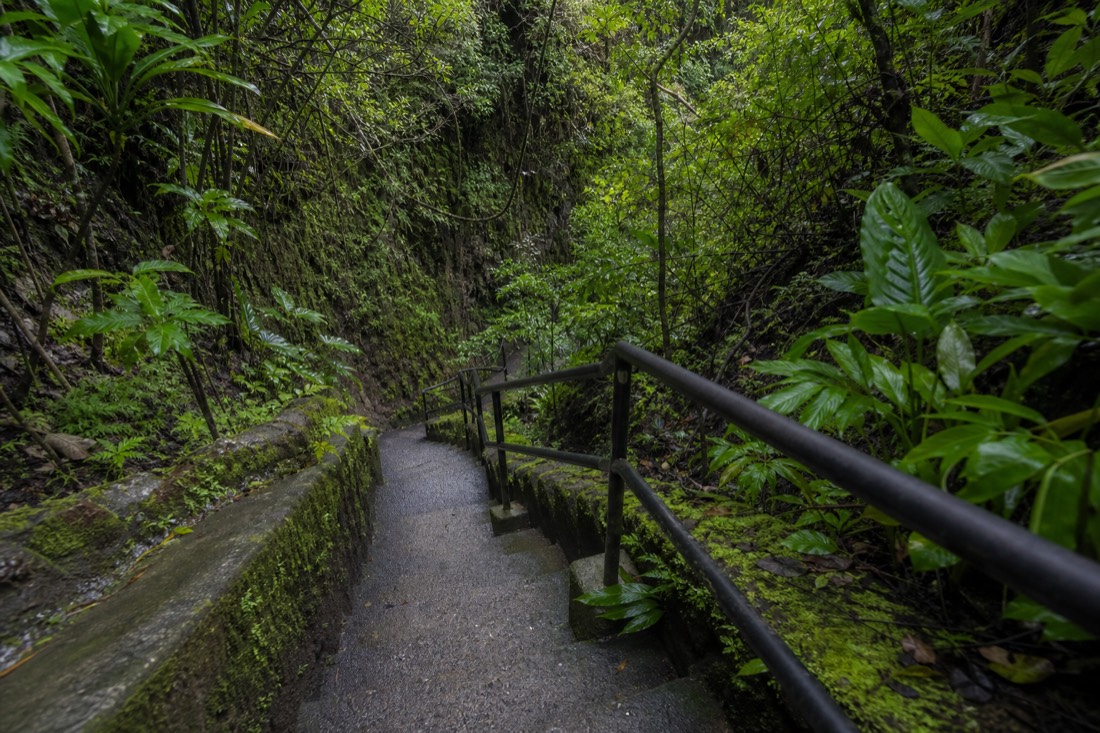
Easier than a real hike, harder than a boardwalk. The path is paved end to end but includes multiple flights of stairs down into the gulch and back out, which is why the state rates it as requiring some physical exertion and does not class it as wheelchair accessible. Fitness matters less than knees.
I read that official phrase, "requires some physical exertion," as a fair warning rather than a scare line. Nobody needs trekking poles here, and no one has ever needed a rescue on my watch. But the stair flights come in clusters rather than singly, so you get a run of steps, a short level stretch, then another run. The return climb arrives at the end, when your legs are already warm and your shirt is already damp. In this climate that last pull is where people slow down and stop talking.
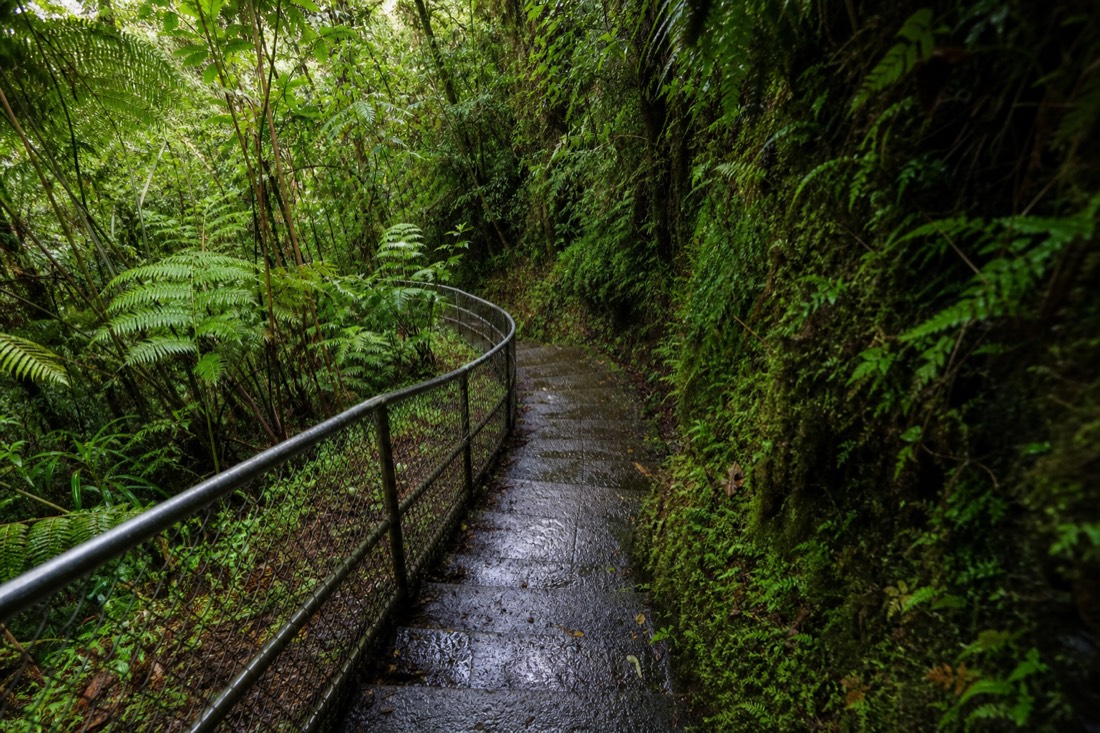
I will not give you a step count or an elevation figure, because the state does not publish either one and I refuse to guess at numbers people will plan their knees around. What I can tell you from a thousand-odd guests is where the difficulty actually lands. It is not cardiovascular. Very few people arrive at the top out of breath in a way that worries them. It is the descending that hurts, specifically for anyone with a bad knee, a recent replacement, or a hip that dislikes stairs. Going down loads the joint far harder than going up, and the loop asks you to go down first, when you are fresh and confident and moving faster than you should be.
Humidity does the rest. The Hamakua Coast sits under near-constant moisture, and the gulch traps it. Even on a clear day the air under that canopy feels like a warm towel, so a body that would shrug off two flights of office stairs works noticeably harder here. Take water. Not much, a small bottle is plenty for a 40-minute loop, but take it.
The people who genuinely struggle are a narrow group: those on walking frames, wheelchair users, anyone who cannot manage an unbroken flight of stairs without a rest, and parents committed to a stroller. For those travellers the shortcut in the next section is not a lesser experience, it is the right experience. I wrote the full honest rundown for families and older travellers in ʻAkaka Falls with kids, strollers and limited mobility.
Pace is the one variable you fully control, and it is the one most guests give away. Groups that treat the loop as a walk rather than a task arrive at the overlook with their breath and their patience intact. A guided day that budgets a full hour at the park rather than a rushed twenty minutes buys you exactly that.
Which direction should you walk the loop, and does it matter?
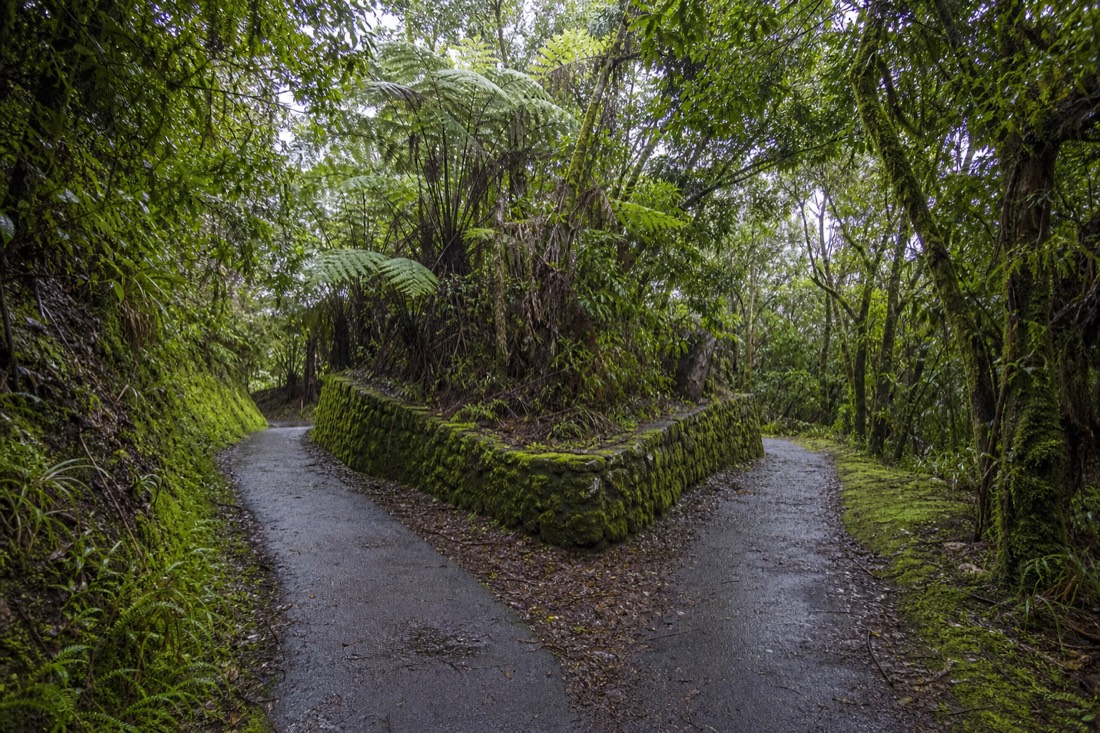
Yes, a little. The loop has two arms from the first junction. Going right takes you the long way around, past Kahuna Falls first and saving the 442-foot main falls for last. Going left runs straight to the big overlook. Either way you finish with a climb.
Most visitors default to whichever arm the crowd in front of them took, which is usually the left, because the sign pointing to ʻAkaka Falls is the one everyone reads. I send guests right for their first visit, and I do it for a simple dramatic reason: the loop is built like a story and the big falls are the ending. Walk it counter-clockwise, past the quiet Kahuna side first, and you get a warm-up waterfall, ten minutes of genuinely lovely forest, then the reveal. Walk it the other way and you spend your best moment in the first eight minutes, after which everything else feels like the walk back to the car.
There is a physical argument too, and it cuts both ways, which is why I tell people not to agonise over it. Whichever direction you choose, the trail returns you to a parking lot that sits above the gulch, so the climb is coming regardless. Going right, the descent is spread across the early Kahuna side and the ascent stacks up in the second half, after the main overlook, when you have already had your payoff and you are willing to work for the exit. Going left, you take a shorter, sharper drop to the big falls, then face the climb back out almost immediately with the whole rest of the loop still ahead if you continue.
For anyone managing a knee, that difference matters more than the scenery order. A stacked climb at the end is usually kinder than a stacked descent at the start, because going up is a muscle problem and going down is a joint problem. Muscles complain. Joints stay complained-about for three days.
Crowd flow is the third factor and the one nobody thinks about. Because the majority go left toward the headline falls, the right-hand arm is often close to empty for the first hour after the gates open. On a busy cruise morning I have had the Kahuna stretch entirely to myself while a queue built at the main rail three minutes away. If you care about hearing the stream instead of other people's phones, that alone decides the direction. Photographers should read the ʻAkaka Falls photography guide before choosing, because the light on the main falls swings hard with the hour.
What is the official shortcut off the loop, and should you take it?
From the first junction near the trailhead, the left-hand south path runs straight to the ʻAkaka Falls overlook and back, skipping the full loop and the Kahuna Falls section. The park's own guidance offers it as the direct option when the main falls are all you want.
The official page spells it out plainly: to view ʻAkaka Falls only, take the left path at the first junction. That is not a locals' hack or a shortcut through the bushes, it is the park's stated route for a shorter visit. It still involves stairs, so treat it as a smaller dose rather than a stair-free bypass. What it trims is the deepest part of the gulch walk and the extra climbing that comes with it.
Here is how I frame the choice for guests standing at that junction with a clock running.
| Full loop | Left-hand shortcut | |
|---|---|---|
| Distance | 0.4 miles | Shorter out-and-back to the main overlook |
| Waterfalls | Kahuna Falls and ʻAkaka Falls | ʻAkaka Falls only |
| Stairs | Multiple flights, down and up | Fewer, but still present |
| Typical time | 30 to 45 minutes | 15 to 25 minutes |
| Best for | Anyone with 40 comfortable minutes | Tight schedules, tired legs, second visits |
| What you give up | Nothing | The quieter Kahuna side and the full gulch forest |
My take after years of walking both: do the full loop the first time if your knees allow it. The Kahuna Falls stretch is the loop's quiet half, usually near empty, and the forest through there is the part guests describe to me weeks later. The shortcut is the right call in three situations, and only three. A cruise-day squeeze where the ship clock is real. A second visit where you already know the loop and just want ten more minutes with the big falls. And a body that has told you, honestly, that another two flights of stairs is a bad idea.
Cruise passengers in particular should not feel they are cheating. You are off the ship for a fixed window, the drive from the pier is short but not trivial, and the falls are the thing you came for. Take the direct path, spend the saved fifteen minutes at the rail instead of on the trail, and get back to the coast road. If your window is that tight, a half-day circuit that handles the driving and the timing for you is worth pricing out. You can see what the half-day Hilo waterfall circuit covers before you commit your own morning to it, and the port logistics are in Hilo cruise port to ʻAkaka Falls.
What do you actually see on the loop?
Two waterfalls and a working rainforest. Kahuna Falls appears first on the full loop, a cascading falls across the valley, and then the trail delivers you to the main event: ʻAkaka Falls dropping 442 feet in a single free fall into a stream-eroded gorge. The forest between them is the underrated part.
Kahuna Falls gets undersold because it sits farther away and is partly veiled by the valley wall and its own vegetation. The state publishes no official height for it, so I will not pin a number on it, but as an opening act it does its job. The viewing is across the gulch rather than beneath it, so bring your zoom if you want a frame-filling shot, and accept that in high vegetation months the view narrows. That is not a fault of the trail. That is a rainforest doing what rainforests do.
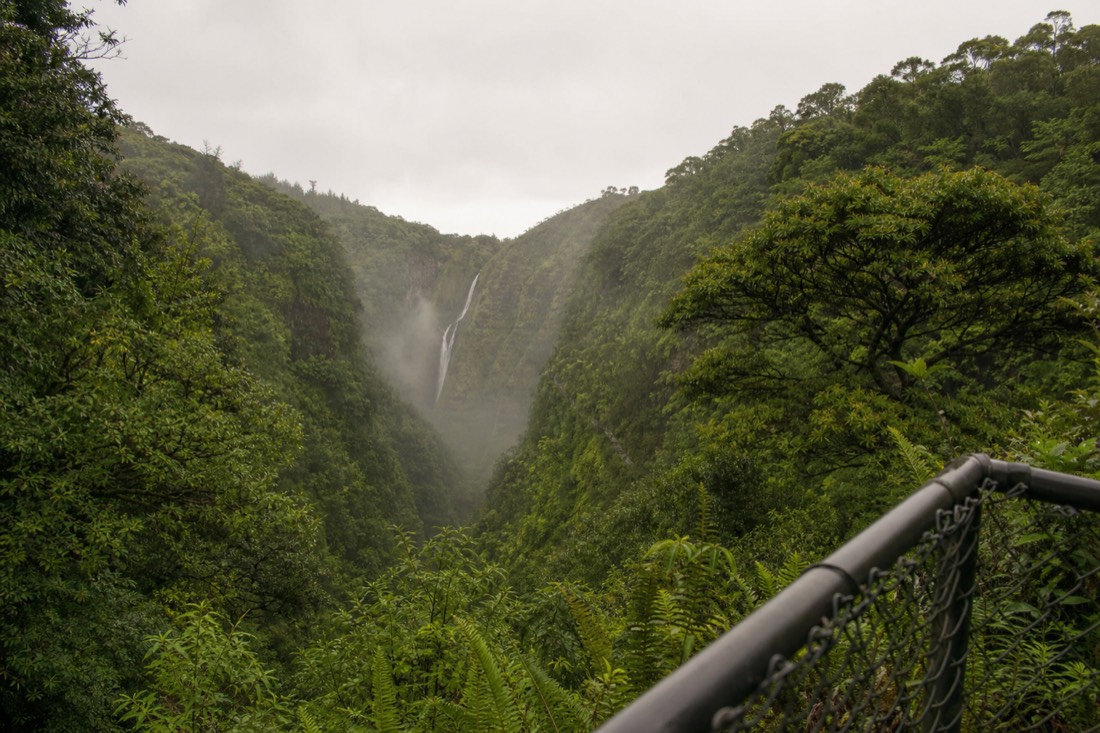
ʻAkaka Falls needs no zoom. The overlook puts the entire 442-foot ribbon in front of you, top to plunge pool, with nothing between you and it but air and a railing. After heavy rain the sound arrives before the view does, a low continuous noise you hear from thirty paces back up the path. In drier stretches the fall thins to a narrower white column and the gorge below shows more of its wet black rock. Both versions are worth the walk. Neither one is the "wrong" day, whatever the person beside you at the rail says.
Everything between the two overlooks is dense Hamakua rainforest, and it is genuinely the half of the loop I would fight to keep. Wild ginger crowds the path edges. Philodendron climbs everything vertical. Bamboo stands rattle in wind you cannot feel down at ground level, and after rain the whole gulch releases side cascades that were not there an hour before. The Hamakua Coast tourism page credits this side of the island with nearly 84 inches of rain a year, and every inch of it is visible in the vegetation.
Guests who walk head-down between overlooks miss most of what they paid the entry fee for. I tell people to treat the two waterfalls as punctuation and the forest as the sentence. If you are trying to work out how this stacks up against the other famous falls twenty minutes away, Rainbow Falls versus ʻAkaka Falls is the honest comparison, and waterfalls near Hilo covers the wider set.
What is the trail surface actually like underfoot?
Paved end to end, edged with stone, and wetter than it looks. The pavement holds a thin algae film in shaded sections, drainage channels cross it in places, and roots have lifted a few slabs into low ridges. Handrails cover the stair flights but not every narrow stretch.
The paving is the single reason this trail carries the traffic it does without turning into a mud chute, and it is also the reason people underestimate it. Pavement reads as "safe" to a visitor brain. Under a rainforest canopy on a coast this wet, paved means smooth, and smooth plus a permanent film of algae and leaf residue means a surface with less grip than the dry concrete you are picturing.
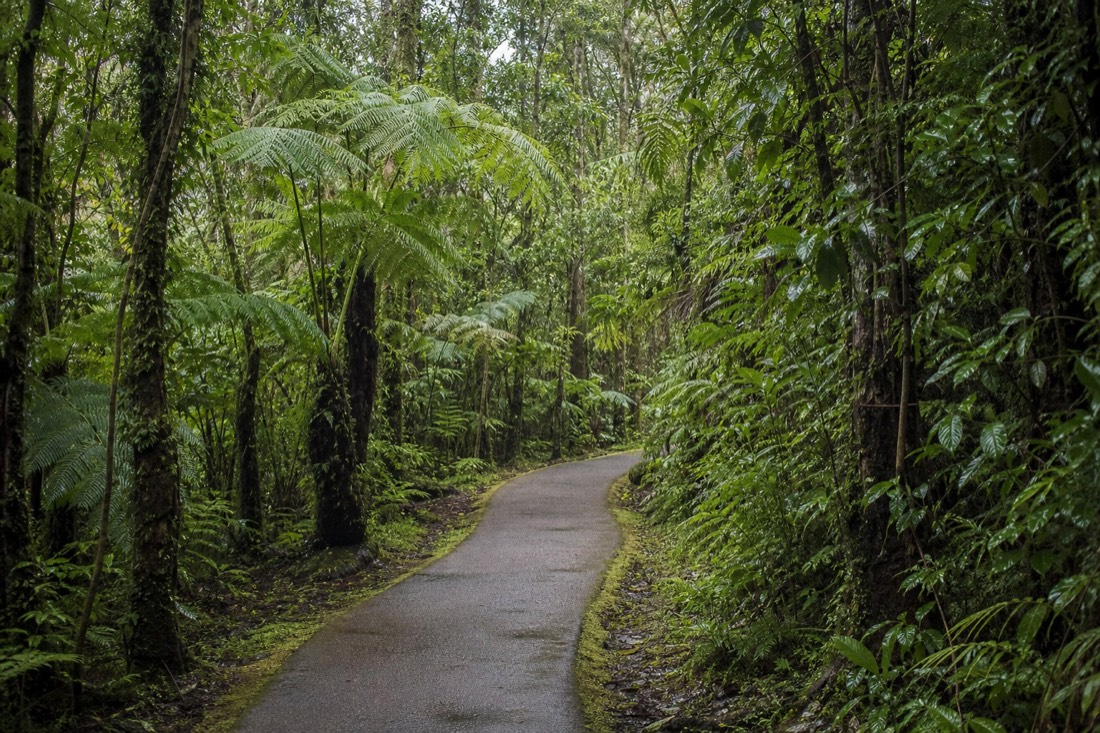
The loop is not uniform, so it helps to know which bits ask for attention and which you can walk without thinking.
| Stretch | Surface character | What to watch |
|---|---|---|
| Trailhead to first junction | Wide, gently graded pavement | Nothing, this is the easy part |
| Descent into the gulch | Stair flights with stone edging | Damp treads, keep a hand near the rail |
| Kahuna side contour | Level to gently rolling pavement | Occasional root heave lifting a slab |
| Gulch low point | Narrower path, heaviest shade | Algae film, standing water after rain |
| Climb toward the main overlook | Sustained stairs in clusters | Pace, not grip |
| Main overlook approach | Level, railed viewing area | Crowding at the rail |
| Final climb to the lot | Stairs plus ramped pavement | Tired legs on wet treads |
Handrails are the detail worth knowing in advance. They run along the stair flights, which is where you need them, but they are not continuous around the entire loop. On a few of the narrower contour sections it is pavement, stone edging, and then hillside. That is fine for a steady walker and awkward for anyone who likes a rail permanently within reach. Plan your hand accordingly, which mostly means not carrying a phone, a coffee and an umbrella all at once.
Two small surface facts save more slips than any advice about shoes. Fallen leaves on wet pavement behave like paper on a tiled floor, so scuff through them rather than stepping on them squarely. And the drainage cuts that run across the path, shallow channels that carry water off the hillside, sit slightly lower than the surrounding slab. Nobody falls in one. Plenty of people catch a toe. My longer list of the things I wish every visitor knew before the gate is in what I wish visitors knew about ʻAkaka Falls.
What should you wear and carry for the hike?
Closed shoes or grippy sandals with real tread, a light rain layer, and nothing you would mourn if it got damp. The loop is paved but frequently wet, the weather flips inside ten minutes, and those stairs punish slick soles far harder than they punish slow legs or poor fitness.
Footwear is the whole conversation. I have watched more near-falls caused by smooth rubber than by any other factor, including rain, age and inattention combined. The pattern is depressingly consistent: someone arrives from a beach morning in flat-bottomed slides, the soles have no tread left, and the first damp stair tread does exactly what you would expect. Anything with a lugged or patterned sole walks out fine.
| Conditions | Footwear that works | Skip |
|---|---|---|
| Dry morning | Trainers, grippy sandals with a heel strap | Smooth-soled slides |
| After rain or drizzle | Trainers with tread, trail shoes | Flip-flops of any kind |
| Full downpour | Trail shoes plus a rain shell | Umbrellas on the stair flights, you need the handrail hand |
| With small kids | Their most secure shoes, laces tied | New shoes with slick soles |
| Straight off the beach | Anything dry from the trunk | Bare wet feet in sandals |
Shorts and a t-shirt handle the temperature fine year-round. The layer question here is entirely about rain, never about cold. A packable shell beats an umbrella for one specific reason: the stair sections want a free hand for the rail, and an umbrella takes it. Guests hate hearing this and then agree with me by the second flight.
Carry almost nothing else. A small bottle of water. Your phone, in a pocket rather than in your hand, because the drop off the rail at the main overlook is not survivable for electronics. A microfibre cloth if you shoot with a real camera, since lens mist is constant near the falls. Bug spray is optional in my experience, mosquitoes are present but not aggressive on the paved sections, and the breeze through the gulch keeps them honest most days. Leave the tripod unless you have a plan for it, because the overlook gets tight and the rail vibrates.
One habit worth building before you go: pay the fee online before you arrive. Reception at the park is weak and the kiosk takes card only, no cash at all. The current fee structure and every way it catches people out is laid out in how much ʻAkaka Falls costs. The same closed shoes carry you straight into the zipline course a few minutes down the road, which is why so many people stack the two into one morning and never open the suitcase in between.
How does rain change the footing on the loop?
Rain does not make the loop dangerous, it makes it slower. Wet pavement under canopy carries a slick film, treads hold standing water, and the sensible response is a hand on the rail and a shorter stride. Most rain here passes inside twenty minutes anyway.
Understand first that rain is not an exception on this coast, it is the operating condition. Nearly 84 inches a year falls on the Hamakua side, and that water is precisely why the falls run all year while other island waterfalls turn to stains on a cliff. Visitors who wait for a guaranteed dry window are often waiting for a day that will not arrive during their trip. I would rather send you up in drizzle with the right shoes than have you skip it.
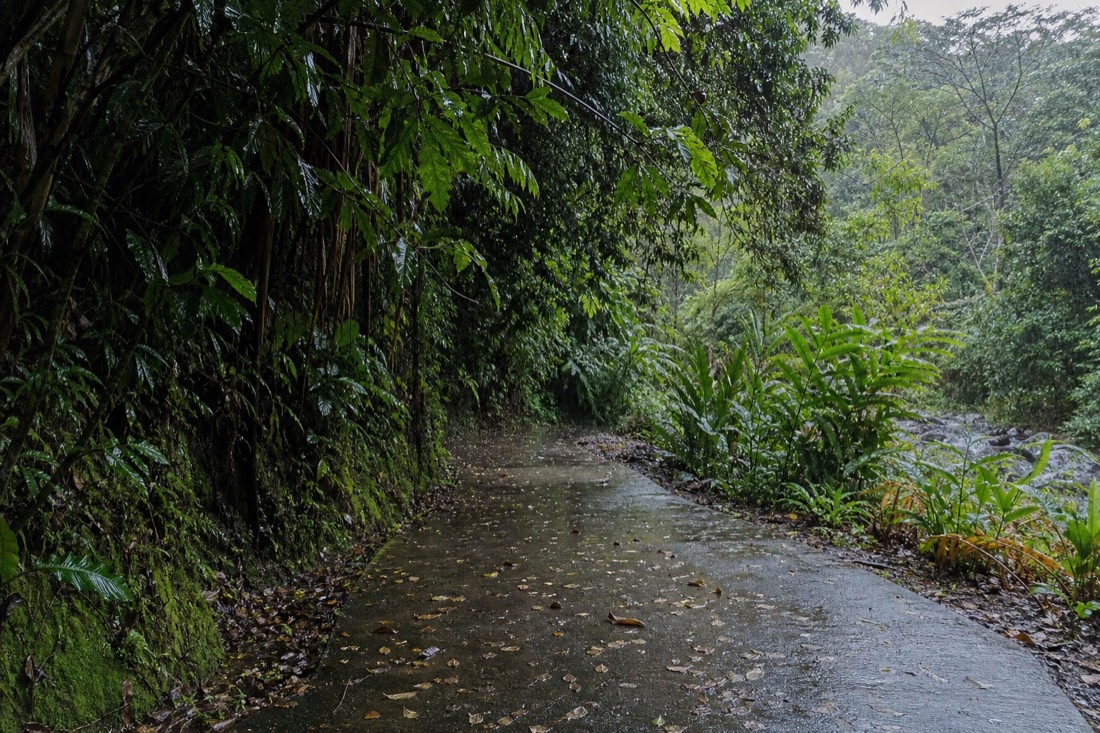
What actually changes when it is wet is worth spelling out, because the risks are not where people expect.
| Condition | What changes underfoot | How I handle it |
|---|---|---|
| Light drizzle | Surface film only, grip mostly intact | Normal pace, hand near the rail on stairs |
| Steady rain | Standing water on stair treads, leaves float | Shorter stride, one hand on the rail, no umbrella |
| Just after heavy rain | Slickest of all, algae lifted and wet | Slow the descents, take the climbs at talking pace |
| Two dry days in a row | Shaded low sections still damp | Only the gulch bottom needs care |
| Windy and wet | Spray reaches the main overlook | Protect the camera, keep both hands available |
The counterintuitive part is that the slip risk and the tire-out risk pull in opposite directions. Rain makes people hurry, and hurrying is the actual hazard. Every genuinely bad moment I have seen on this trail involved someone moving faster than the surface allowed because they wanted to get out of the weather. The stairs are where speed costs you, and they are also the only part of the loop that has no soft landing.
My rule for wet days is simple and I say it out loud at the trailhead: one hand stays free. Not for balance in some abstract sense, but so it can find the rail without a decision. That means the phone goes in a pocket, the umbrella stays in the car, and if you are wrangling a small child you hold the child, not the child's snack. Rain gear that lets your hands work beats rain gear that occupies them, every time.
There is also a genuine upside nobody mentions until they have seen it. The falls run heavier after rain, the gulch throws up side cascades that vanish by afternoon, and the crowd thins to almost nothing. Some of the best mornings I have had on this loop were the ones the forecast told everyone else to skip. I wrote one of them up in rain at the falls.
When should you walk the loop?
Gates open at 8:30am and close at 5:00pm daily. Early is better on every measure: quieter trail, cleaner light on the falls, cooler climb, easier parking. If you arrive after 3:30pm you are working against the clock, and after 4:00pm you are rushing the best part.
Those posted hours are the frame for everything else. The park is not open at dawn, so the sunrise-photography plan people arrive with does not exist here. What you can do is be one of the first cars through at 8:30, and I would take that over almost any other planning decision. The lot fills in waves through late morning, the tour vehicles arrive in a predictable band, and by early afternoon the main rail rarely stands empty for more than a minute at a time.
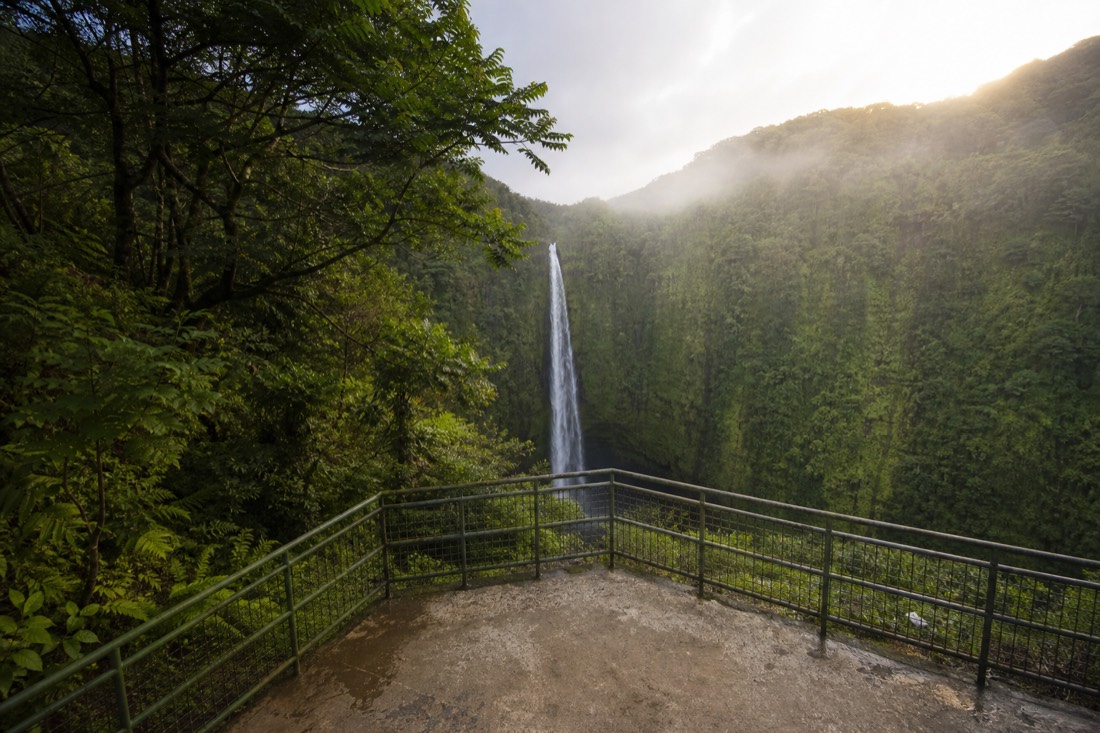
Here is the day as I actually experience it, guiding through it week after week.
| Arrival window | Trail feel | Light on the falls | Parking |
|---|---|---|---|
| 8:30 to 9:30am | Quietest of the day | Soft and even, shadows still low | Easy |
| 9:30 to 11:00am | Building steadily | Good, improving on the main falls | Usually fine |
| 11:00am to 2:00pm | Busiest band | Harsh overhead, high contrast | Waves of full and clearing |
| 2:00 to 3:30pm | Thinning out | Warming, cloud often builds | Easy again |
| 3:30 to 4:15pm | Quiet, last real window | Flat and often grey | Easy |
| After 4:15pm | Rushed, gates close at 5:00pm | Fading fast under canopy | Empty |
That 3:30pm line is the one I would tattoo on rental car dashboards. The gate closes at 5:00pm, not the trail, and you want to be walking out well before that. Arriving at 4:30 gives you a technically legal visit and a genuinely poor one: no time for the full loop, no time to stand still, and a good chance you are the last car in the lot while someone waits to lock up. Give the place 45 minutes with room either side and it repays you.
Afternoon has one specific advantage worth knowing. The mid-day tour wave has passed, and between roughly 2:00 and 3:30 the trail can go quiet again while the light warms. It is not the photographer's hour that morning is, but the trade for solitude is real. The seasonal patterns, the rain months and the flow differences are in the best time to visit ʻAkaka Falls, and if you want to see what a good early start actually feels like, a morning at ʻAkaka Falls is that walk written down.
Most people are not building a day around this loop alone, and they should not. Forty minutes of walking wants a coast drive attached to it, or a volcano, or Honomū's wooden storefronts ten minutes back down the hill. If you would rather have somebody else time all of that, you can see how the Hilo day is scheduled, and the perfect ʻAkaka Falls day is my own version if you are driving it yourself.
Who will struggle, and what this hike is not
This is a fenced viewing loop in a state park, not a wilderness hike. There is no route down to the gorge, no water access, no swimming, no bikes and no off-trail wandering. It will genuinely defeat wheelchair users, stroller-pushers and anyone who cannot manage stairs.
Let me handle the disappointments first, because managing them beforehand is most of the job. People arrive expecting to get to the bottom of the falls. You cannot. The gorge below the 442-foot drop has no legal or safe access from this trail, the slopes are steep and saturated, and the loop is fenced for exactly that reason. There is no swimming here at all, a fact I have to deliver several times a week to guests with towels in their bags. The full explanation, including where you actually can get in the water on this island, is in can you swim at ʻAkaka Falls.
The official rules are short and I would rather you read them from me than from a ranger. No mountain biking. Stay on the trail. No open fires. Pack out what you pack in. None of that is unusual, and all of it is enforced.
| Traveller | How the loop treats them | Better plan |
|---|---|---|
| Wheelchair user | Not accessible, per the official park page | View from the parking area, spend the time on the coast drive |
| Stroller with a baby | Stairs make it impractical | Carrier instead of stroller, or the left-hand shortcut |
| Bad knee or recent surgery | The descents are the problem, not the climbs | Left-hand shortcut, take the stairs one at a time |
| Small children, walking age | Fine and usually delighted, hold hands on stairs | Full loop, allow an extra fifteen minutes |
| Anyone in smooth-soled sandals | Slips waiting to happen on wet treads | Change shoes at the car |
| Hikers wanting a real trail | Too short to satisfy | Add the coast, the volcano or a longer guided walk |
| Visitors hoping to swim | No water access anywhere on the loop | A guided waterfall hike that ends somewhere swimmable |
That last row is the one I get asked about most. If getting into the water is the point of your day rather than a bonus, do not spend the morning being frustrated at a railing. There are guided hikes on this island that end at a pool you can actually swim in, with a Native Hawaiian guide who can tell you what you are looking at, and you can look at how that half-day runs instead. Come to ʻAkaka Falls for the view, and get wet somewhere designed for it.
What this hike is, when you strip away what it is not, is one of the highest ratios of payoff to effort anywhere in Hawaii. Four tenths of a mile. Two waterfalls, one of them 442 feet of unbroken free fall. A 65.4-acre pocket of rainforest that feels older than the road you drove in on. You will spend more time getting there than walking it, and nobody who has stood at that rail has ever told me the drive was a mistake.
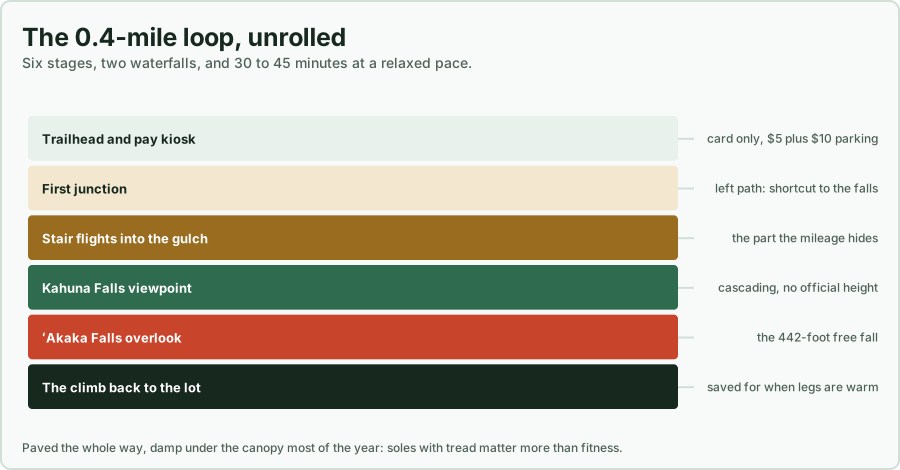
The loop rewards unhurried walking far more than it rewards speed. Take the stairs at talking pace, give the quiet Kahuna side its five minutes, and let the big overlook hold you as long as it wants to. Point four miles has rarely carried so much.
Guided days built around the loop
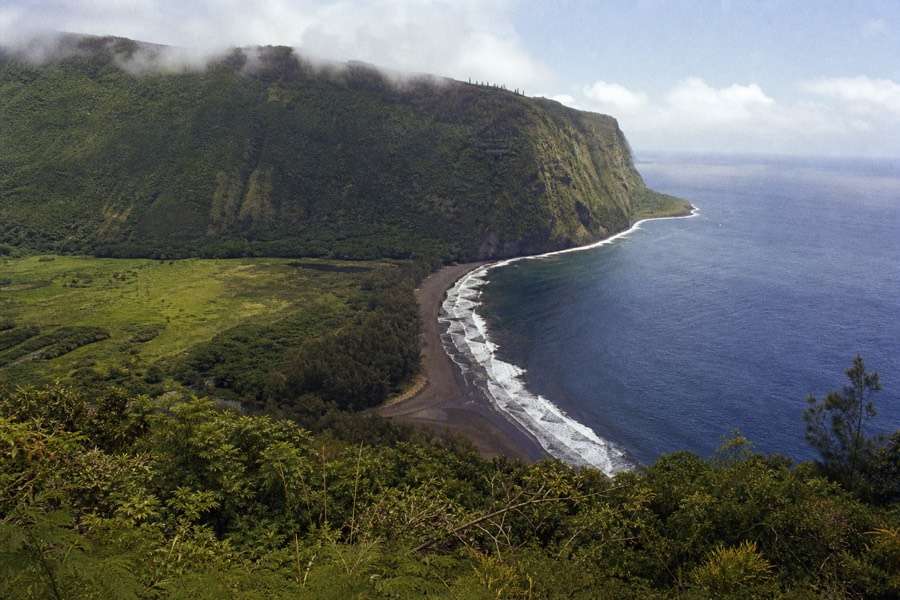
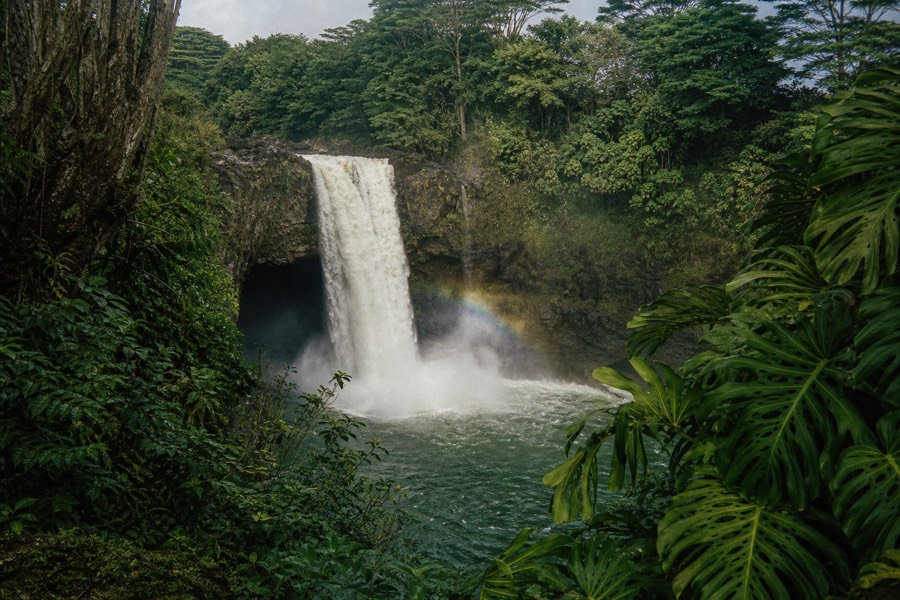
Akaka Falls, Volcanoes & Hilo day (full hour at the falls)
7 to 8 hours
from $179per person, varies by date Check availability →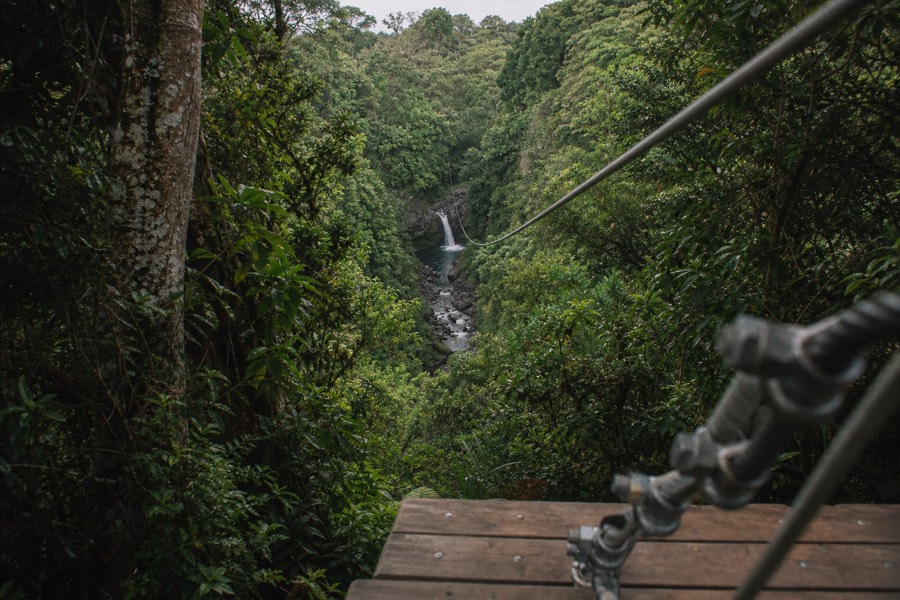
Zipline over KoleKole Falls, next to Akaka Falls
About 2.5 hours
from $246per person, varies by date Check availability →