Majestic waterfall half-day from Hilo
Half day
from $229.99per person, varies by date Check availability →Five named falls sit within a short drive of Hilo. Only one is 442 feet, and none of them work the way visitors assume.
 Verified by Kekoa Kalani, Akaka Falls tour guide and island nature specialist
Short answer
ʻAkaka Falls (442 ft) is the headline, with Kahuna Falls visible from the same loop. In town, Wailuku River State Park holds the 80-ft Rainbow Falls plus Peʻepeʻe Falls and Boiling Pots. KoleKole Falls, 250 ft per the operator's listing, is the one you can fly over. All are viewpoints, not swimming holes.
Guests ask me to rank the waterfalls near Hilo about as often as they ask about the weather, and my answer has not changed in a decade of guiding: it depends on what you want a waterfall to do. If you want scale, one answer. Rainbows, another. If you want to fly over one on a cable, that is a third answer entirely. What follows is the comparison I give in the van, with the numbers I can actually stand behind.
A ground rule first, because this is where lists about Hilo waterfalls go wrong. I only print heights that come from an official page or the operator's own listing, and where no reliable height exists I say so instead of copying whatever figure the internet has agreed to repeat. That leaves this page shorter on numbers than most and considerably more useful.
Four viewpoints need almost no walking: Rainbow Falls and Boiling Pots inside Wailuku River State Park in Hilo itself, and ʻAkaka and Kahuna Falls on a 0.4-mile paved loop 11 miles north. The loop has stair sections and the state calls it moderately physical, but it is a footpath, not a hike.
Start in town. Wailuku River State Park covers 16.3 acres in two separate sections off Waiānuenue Avenue, open daily 7:00am to 5:30pm with the gates locked at 6:00pm. Rainbow Falls, known in Hawaiian as Waiānuenue, drops 80 feet and is famous for the rainbow that forms in its mist on sunny mornings. Upstream, the Boiling Pots section overlooks a succession of big pools lined with hexagonal basalt columns formed as lava cooled slowly, with Peʻepeʻe Falls feeding them from above. The state page also records the local tradition placing Hina, mother of the demigod Māui, in the cave behind Rainbow Falls.
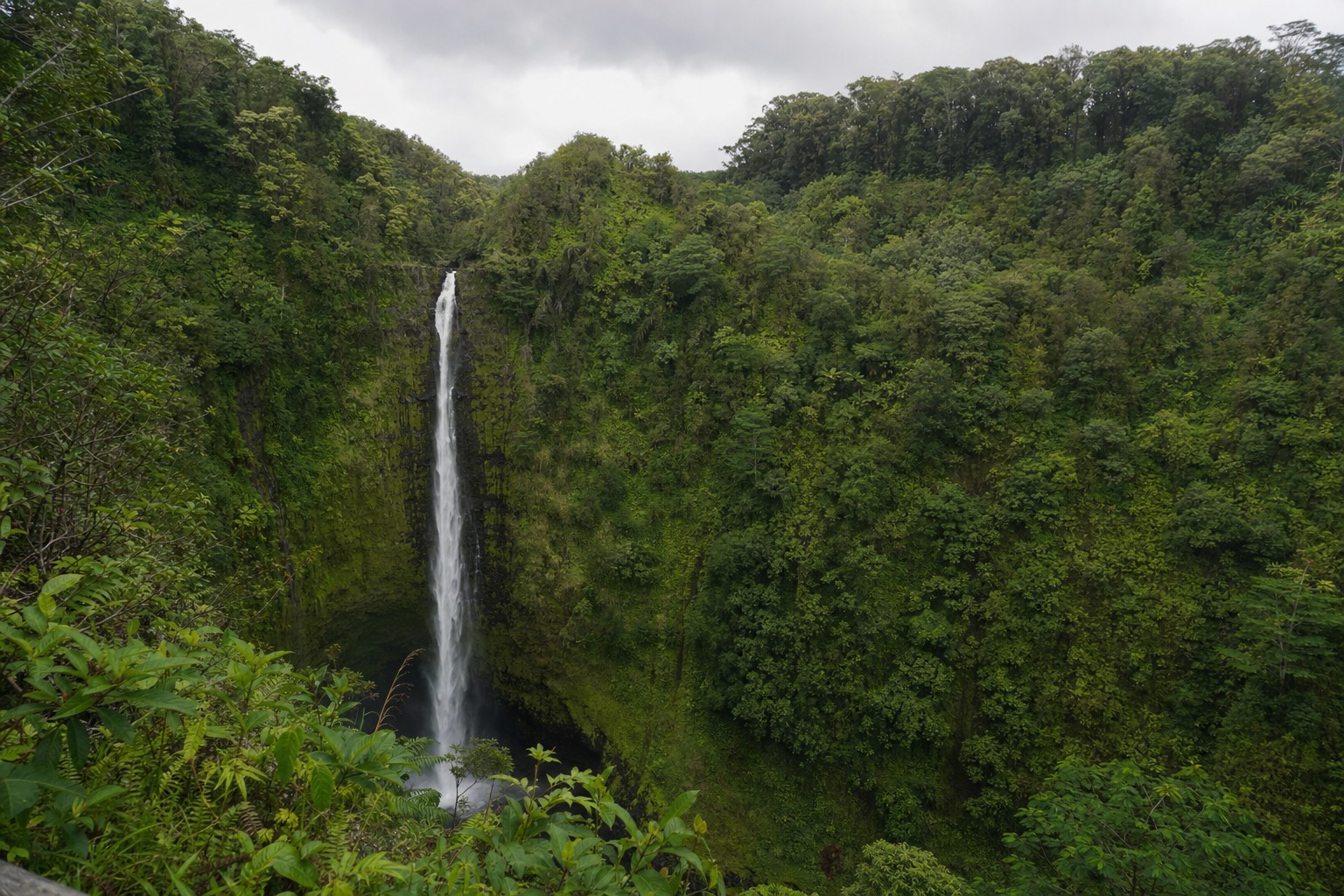
Then the main event. ʻAkaka Falls State Park holds two falls on one loop: ʻAkaka, free-falling 442 feet into its stream-eroded gorge, and Kahuna Falls, a cascading fall the park's own page gives no height for, so neither do I. The loop is 0.4 miles, paved, with steps in places, and it is not wheelchair accessible. If you only want ʻAkaka, the left path from the first junction is the official shortcut. The full walkthrough lives in the trail guide.
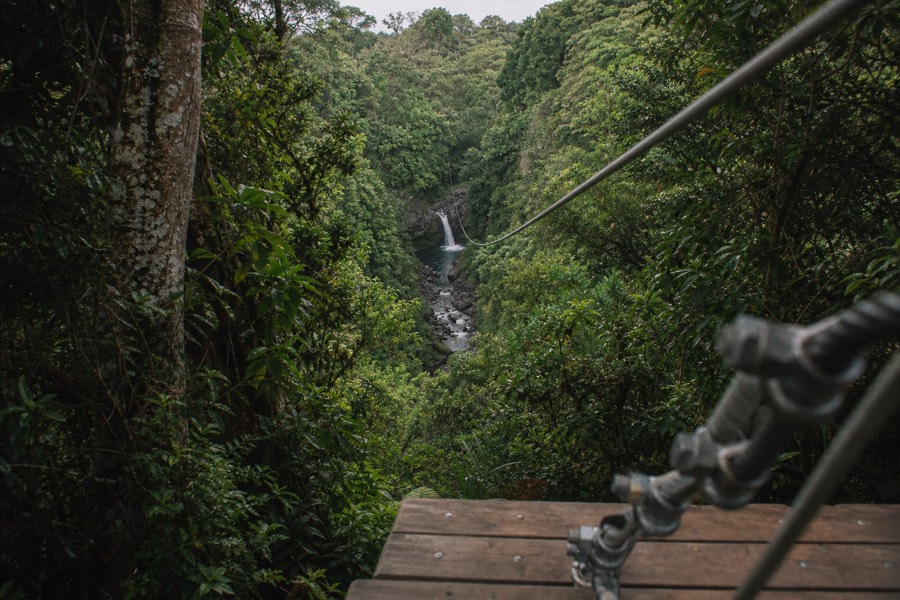
KoleKole Falls rounds out the list, and it is the odd one. It sits near the park on the same stream system, listed at 250 feet by the operator whose zipline crosses it, and unlike the others you experience it from above rather than from a rail. There is no public trail to its base. More on that below.
| Falls | Height | Where | Access | Fee (non-resident) | Swimming |
|---|---|---|---|---|---|
| ʻAkaka Falls | 442 ft (official) | State park, 11 mi north of Hilo | 0.4-mi paved loop, stairs | $5 per person + $10 parking, card only | No, fenced viewing trail |
| Kahuna Falls | No height on the park page | Same loop as ʻAkaka | Same loop | Included in same entry | No |
| Rainbow Falls | 80 ft (official) | Wailuku River SP, in Hilo | Steps from the lot | $5 per person + $10 parking, card only | Not offered; viewing area |
| Peʻepeʻe Falls / Boiling Pots | No official height published | Wailuku River SP, upriver section | Overlook by the lot | Same park entry | Not offered; viewing area |
| KoleKole Falls | 250 ft (per the operator's listing) | Near the state park | Zipline course crosses it | Tour price on the listing | No, it is an overflight |
Read that swimming column twice. At ʻAkaka the loop is a fenced viewing trail above a closed gorge, and there is simply no water access; the swimming guide explains why that is the right call. At Wailuku River State Park the official page describes overlooks and offers no swim access either. A wet volcanic river system is not a water park, and the guides who work here treat it accordingly.
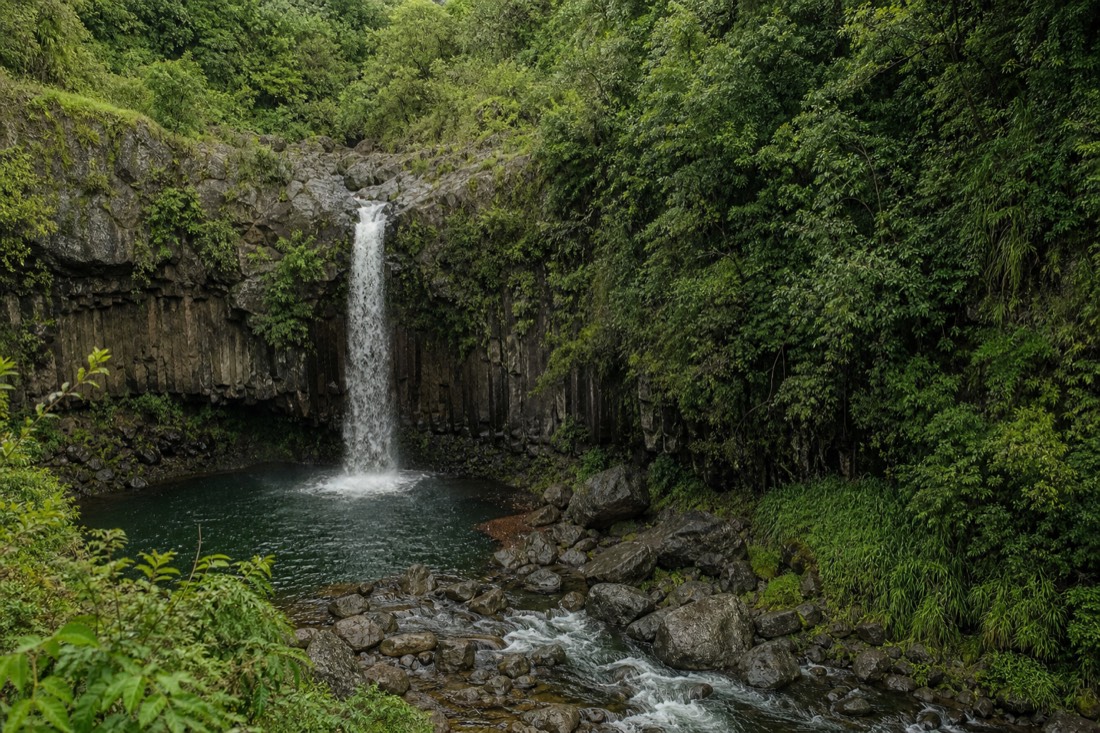
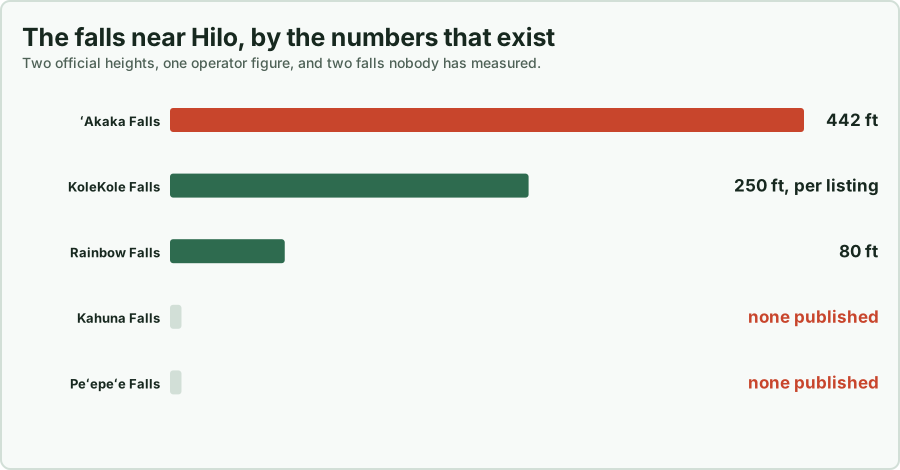
Two numbers are official: ʻAkaka at 442 feet and Rainbow Falls at 80 feet, both from the state parks pages. KoleKole's 250 feet comes from the operator that flies over it. Kahuna and Peʻepeʻe have no height on the park pages, and every figure you see quoted for them online traces back to somebody's estimate.
I labour this point because waterfall heights are the most confidently repeated bad data in Hawaiʻi travel writing. A number appears once, it gets copied into a listicle, that listicle gets scraped into another, and within a few years a guess has the texture of a measurement. When guests quote me a figure I have never seen on an official page, I can usually find where it came from and it is never a survey.
So here is the provenance, plainly. The state's ʻAkaka Falls page says the waterfall plunges 442 feet into a stream-eroded gorge, and describes Kahuna Falls as cascading without attaching a number to it. The Wailuku River page gives Rainbow Falls at 80 feet and says nothing about the height of Peʻepeʻe Falls. The 250-foot figure for KoleKole appears on the listing of the operator whose cable crosses above it, which is a commercial source rather than a state one, and I flag it as such every time I use it.
What that means for you is small but real. If a guide, a sign or a blog quotes you a precise height for Kahuna, treat it as decoration. And do not let the missing numbers put you off the falls themselves. Kahuna is a genuinely lovely cascade that would headline a smaller island, and Peʻepeʻe feeding the basalt pools is one of the strangest bits of geology on this coast. They just have not been officially measured.
| Falls | Height claim | Source type | How I treat it |
|---|---|---|---|
| ʻAkaka Falls | 442 ft | State parks page | Printed as fact |
| Rainbow Falls | 80 ft | State parks page | Printed as fact |
| KoleKole Falls | 250 ft | Operator listing | Printed with attribution |
| Kahuna Falls | None on the park page | No official figure | Left blank |
| Peʻepeʻe Falls | None on the park page | No official figure | Left blank |
ʻAkaka wins on scale and drama, five and a half times the height, with a gorge and a rainforest loop around it. Rainbow Falls wins on convenience and morning light, minutes from downtown with its namesake rainbow in the mist. They are twenty-five minutes apart, so the real answer is both, ʻAkaka first.
This is the single most common either-or question I get, and I wrote a full page on it at Rainbow Falls vs ʻAkaka Falls. The short version: they are different instruments. ʻAkaka is a set piece, a 442-foot ribbon dropping into a green gorge with the sound arriving before the view. Rainbow Falls is a moment, best on a sunny morning when the mist does its trick, and it costs you barely twenty minutes of a day.
Height is not everything, and I say that as the guide who brings people to the tall one. Rainbow Falls sits on the Wailuku River inside town, which means broad flow after rain and an easy add-on for anyone. It also has something ʻAkaka does not: you can get physically close to it, standing at a rail with the river right there rather than looking across a gorge at a distant white line. For visitors with mobility limits, that closeness matters more than the extra 362 feet.
Kahuna, the quiet one, is the falls people forget they saw. It appears from the far side of the ʻAkaka loop as a cascading drop through the trees, easy to walk past if you are hurrying toward the main viewpoint. Guests who take the loop clockwise and slowly tend to remember it. Guests who take the shortcut never see it at all, which is a fair trade if your knees are the limiting factor.
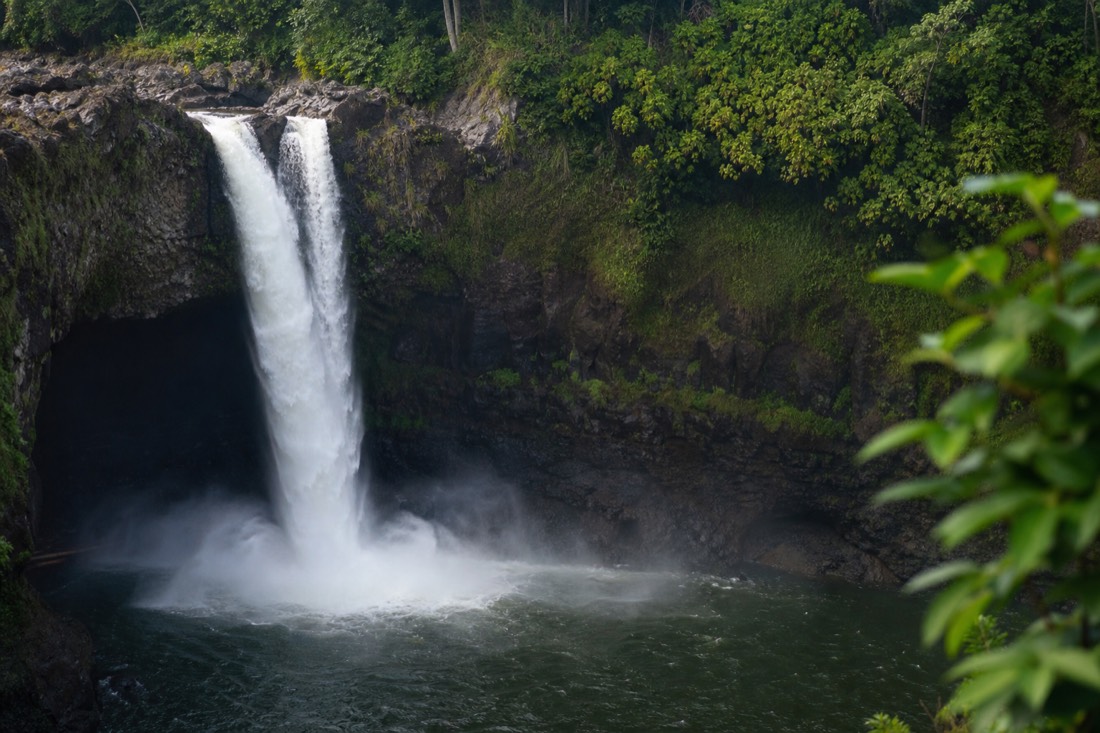
Both charge non-residents $5 per person plus $10 per vehicle, credit card only, with Hawaiʻi residents free on ID. ʻAkaka opens 8:30am to 5:00pm. Wailuku River runs longer, 7:00am to 5:30pm with the gates locked at 6:00pm, and one payment there covers both Rainbow Falls and Boiling Pots.
The fees changed relatively recently at the Wailuku River park, which is why older pages still describe Rainbow Falls as free. It is not, for non-residents. Both parks now use the same structure and both take card only, with no cash accepted at the machines. Children three and under are free at ʻAkaka. The state encourages paying for ʻAkaka before you arrive, because cell reception at the park is poor and a payment system that cannot reach a network is a payment system that cannot take your money.
There is one detail that saves people real money and almost nobody knows it. Wailuku River State Park has two separate sections, the Rainbow Falls side and the Boiling Pots side upriver, and a single entry payment covers both. Guests who drive between them and pay twice are not rare. Keep the receipt or the confirmation on your phone.
The commercial rates are different and they explain something about tour pricing. State parks charge permitted commercial vehicles by capacity rather than per head, which is why an included admission on a guided itinerary is not simply your $5 handed over on your behalf. If you want the full accounting of what a falls day costs either way, how much ʻAkaka Falls costs breaks it down line by line.
| Park | Hours | Non-resident entry | Parking | Notes |
|---|---|---|---|---|
| ʻAkaka Falls State Park | 8:30am to 5:00pm daily | $5 per person, card only | $10 per non-commercial vehicle | Pay before arrival, weak signal at the gate |
| Wailuku River State Park | 7:00am to 5:30pm daily | $5 per person, card only | $10 per non-commercial vehicle | Gates lock 6:00pm; one payment covers both sections |
| Residents at either | Same hours | Free with Hawaiʻi ID or licence | Free with ID | Bring the physical ID |
Yes, comfortably. Start at ʻAkaka Falls when the park opens at 8:30am, walk the loop in under an hour, then drive back toward Hilo for Boiling Pots and Rainbow Falls. You will have seen four named waterfalls by noon for two park entries and a little fuel.
Here is the routing I run, tested on more guest mornings than I can count. It goes north first, then works back south, which is the opposite of what most people plan and considerably better in practice. The reason is parking. ʻAkaka's lot is small and it is the one that fills; Wailuku's two lots turn over constantly and are rarely a problem at any hour.
| Time | Stop | What you are doing |
|---|---|---|
| 8:30am | ʻAkaka Falls State Park | Full loop, ʻAkaka and Kahuna, before the lots fill |
| 9:45am | Honomū | Coffee stop in the old plantation town |
| 10:30am | Boiling Pots overlook | Basalt pools and Peʻepeʻe Falls, five minutes from the lot |
| 11:00am | Rainbow Falls | Best when sun hits the mist |
| 11:30am | Downtown Hilo | Lunch, done by noon |
Two payment notes so the morning goes smoothly. Both parks charge non-residents separately, so budget for two entries rather than one, and pay for ʻAkaka online before you leave your accommodation. Hawaiʻi residents are free with ID at both. Hours differ as well: Wailuku opens at 7:00am and ʻAkaka not until 8:30am, so if you are an early riser there is an argument for doing Rainbow Falls first in flat dawn light and then heading north.
If you would rather have the morning stitched together for you, with the driving and the timing handled, the half-day waterfall circuit out of Hilo is built around exactly this idea and fits inside a cruise call or a half-free day. Fair warning from the honest column: with a rental car and this page, the self-drive version costs two park fees and a tank of fuel, and you can linger wherever you like.
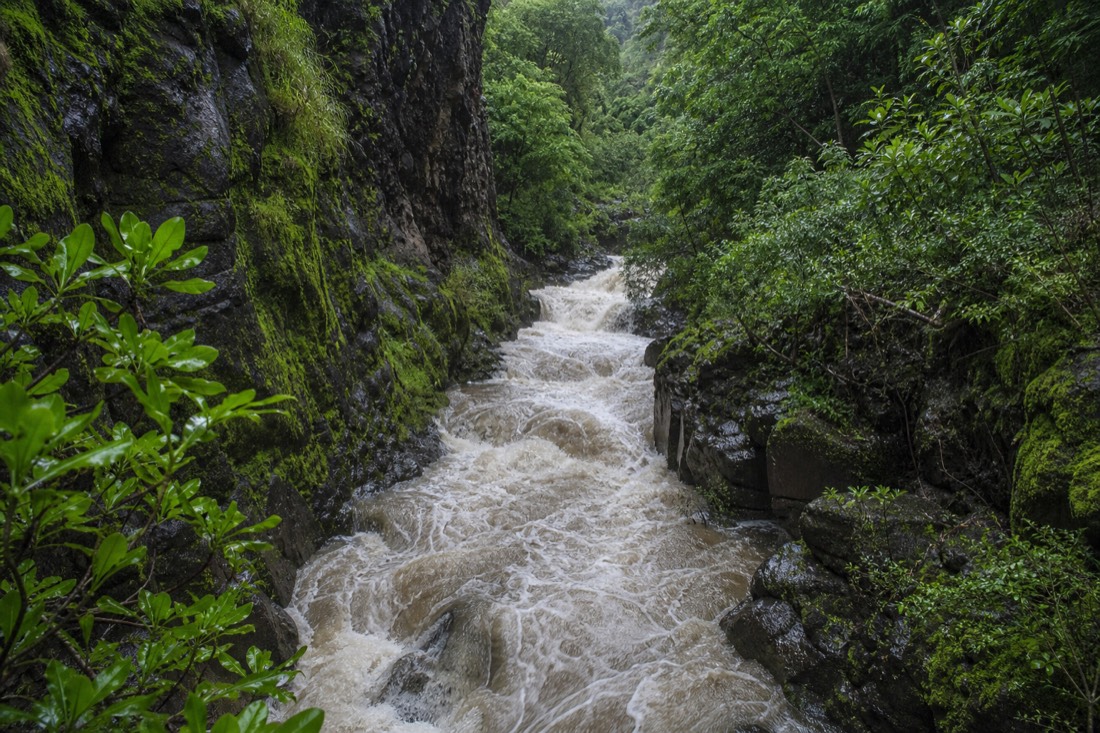
Not at the state parks. ʻAkaka is a fenced viewing loop above a closed gorge, and Wailuku River State Park offers overlooks rather than water access. The Wailuku River in particular has a long history of drownings. The honest answer for swimming is a guided trip to private land where a pool is actually safe to enter.
I get asked this constantly, usually by people who have seen a photograph of somebody standing under a waterfall on this island and assumed it was one of these. It was not. The two parks on this page are viewing parks, and the reasons are physical rather than bureaucratic. At ʻAkaka the falls drop into a gorge with no path down and walls that would be a rescue problem even for someone uninjured. At Boiling Pots the pools look inviting and the river underneath them moves through submerged channels between the basalt columns, which is precisely the sort of hydraulic that traps people.
There is also a health angle worth knowing. Fresh water on this island can carry leptospirosis, and the advice from local sources is consistent: do not enter streams and rivers with open cuts, and stay out of water below heavy rain runoff. That applies to the pretty roadside pools people are tempted by on the coast road as much as it does to the Wailuku.
Where you can swim under a waterfall is on land the public cannot reach alone. A guided waterfall hike and swim led by a Native Hawaiian guide takes small groups to a pool on private ground with the access sorted and someone present who knows the water. If getting in is the point of your day rather than a bonus, that is the answer, and the guided hike and swim with a Native Hawaiian guide is the one I send those guests to rather than watching them try to improvise something unsafe.
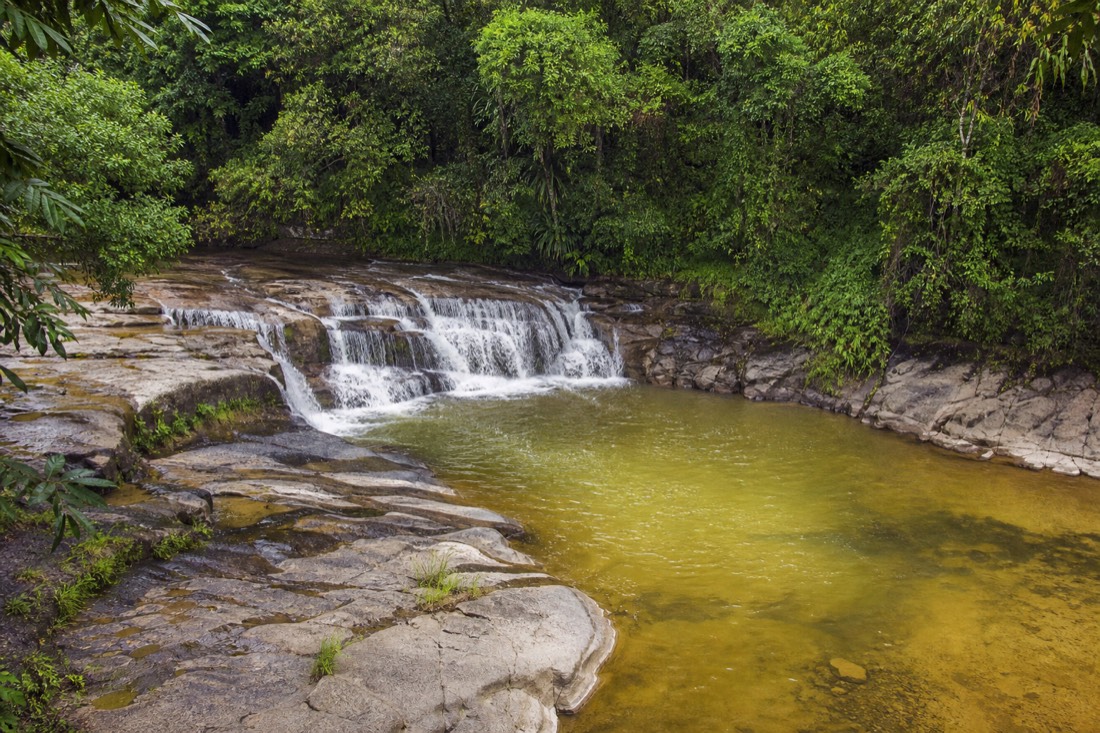
KoleKole Falls. A roughly two and a half hour zipline course crosses above it near the state park, with the final line running over the water. It does not cross ʻAkaka Falls, and any page suggesting otherwise is selling you something that does not exist.
Let me draw that line sharply, because operators' marketing sometimes blurs it and I refuse to. The zipline crosses KoleKole Falls, listed at 250 feet by the operator, on the same stream system a few minutes from the park gate. That is a genuine thrill and the last line does put a waterfall under your feet. Nobody hangs above the 442-footer, though, and no honest page will tell you otherwise.
Practically, it slots into a falls day better than almost anything else on this coast, because it is close. You can walk the loop at opening, be finished by 9:30am, and be on a cable by mid-morning without driving anywhere significant. That proximity is the entire argument for it, and it is why I recommend it to people who have an afternoon to fill and no appetite for the long coast drive north. Passengers off a ship can get a version that collects them at the terminal, which the cruise port guide covers in detail, and my honest brief for first-timers is in what I tell guests before their first zipline.
The one caution I give is about expectations of scale. From a cable you are moving, the canopy is close, and a 250-foot waterfall reads very differently from up there than a 442-foot one does from a fixed rail. If your priority is looking at a big waterfall properly, do the park first and the cable second, in that order, every time.
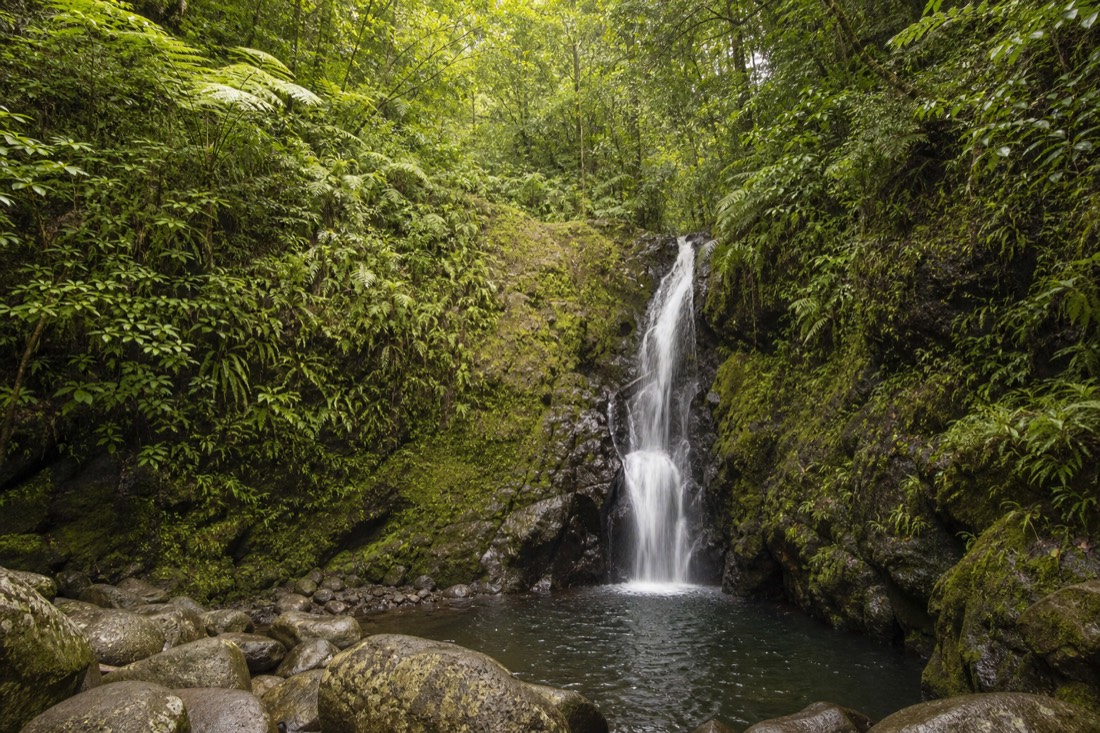
Rainbow Falls and Boiling Pots are essentially step-out-of-the-car viewpoints. ʻAkaka is a 0.4-mile paved loop with multiple stair sections that the state describes as requiring some physical exertion. The zipline needs a harness, a weight range and a reasonable level of mobility.
Effort is the axis that decides these falls for a lot of families, and it is badly covered elsewhere. The state's own wording about the ʻAkaka loop is honest: paved, short, and not wheelchair accessible, with steps in multiple places. In practice most reasonably mobile people manage it fine, taking twenty-five to forty minutes, but the stairs are real and they come in runs rather than singly. Humidity makes them feel longer than they are.
The shortcut matters here. Taking the left, southern path from the first junction brings you to the main ʻAkaka viewpoint with substantially less climbing, at the cost of missing Kahuna Falls and the bamboo section. For grandparents, for anyone with a knee, or for a group with a stroller they cannot use anyway, that trade is usually the right one. I go through it properly in the kids and seniors guide.
| Falls | Walking involved | Surface | Suitable for |
|---|---|---|---|
| Rainbow Falls | Under 2 minutes | Paved, few steps | Almost everyone |
| Boiling Pots | Under 5 minutes | Paved overlook | Almost everyone |
| ʻAkaka Falls, shortcut | About 10 minutes each way | Paved with some steps | Most mobile visitors |
| ʻAkaka Falls, full loop | 25 to 40 minutes | Paved, multiple stair runs | Anyone comfortable with stairs |
| KoleKole from a cable | Harness and platforms | Course infrastructure | Within the operator's weight and age limits |
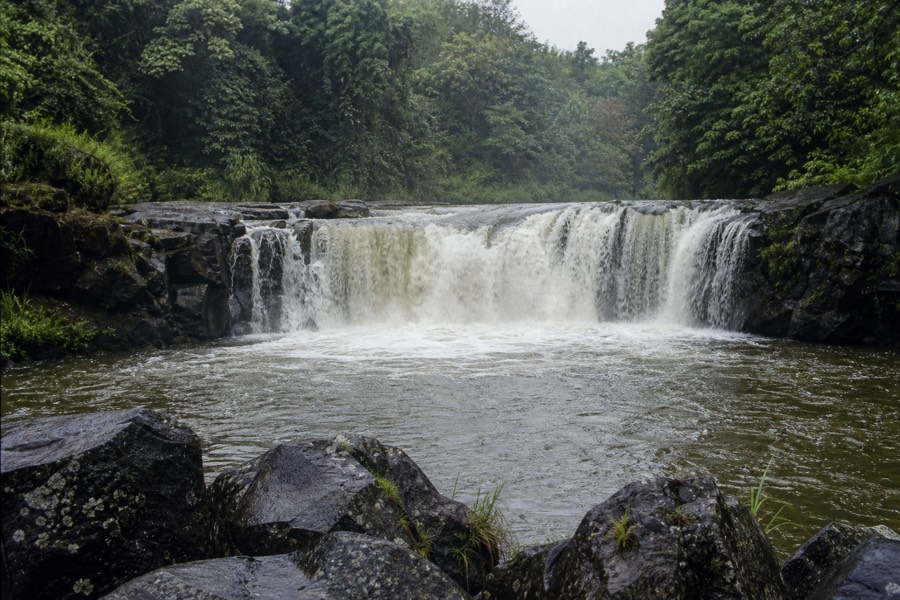
All of them, but not equally. ʻAkaka goes from a ribbon to a rope and starts throwing spray across the gorge. Rainbow Falls widens dramatically and can lose its rainbow to cloud in the same storm. Boiling Pots is the one that transforms, from stepped pools to a single churning river.
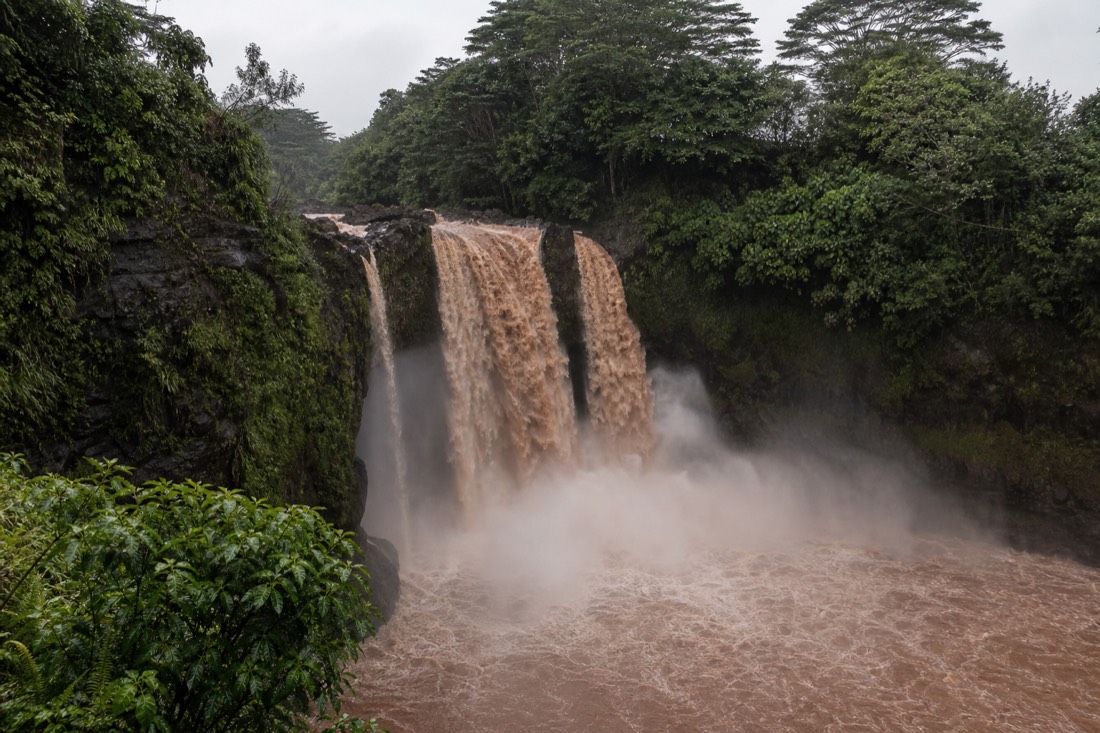
This coast takes nearly 84 inches of rain a year, and that water is the reason any of these falls exist. What varies is the delivery. A steady week of showers gives you good, consistent flow. A single heavy overnight downpour gives you something else entirely, and the morning after is my favourite time to be at any of these viewpoints.
Boiling Pots earns its name in those conditions. In normal flow it is a staircase of separate green pools with dry columnar rock between them. After a real storm the pools merge and the whole riverbed becomes one moving surface, which is both spectacular and a good visual argument for why nobody should be down there. Rainbow Falls behaves the opposite way for photographers: more water, more mist, and often the cloud cover that kills the rainbow the falls are named for.
At ʻAkaka the change is about mass and noise. The plunge widens, spray fills the lower gorge, and on the wettest mornings the bottom of the drop simply disappears into white. The viewpoint stays open, the trail is paved, and the crowd thins because people cancel for weather. I have written about that trade at length in rain at the falls, and about how the seasons behave in the best time to visit guide.
| Conditions | ʻAkaka Falls | Rainbow Falls | Boiling Pots |
|---|---|---|---|
| Dry spell | Narrow ribbon, still impressive | Thin, rainbow likely on sun | Separate green pools, columns exposed |
| Normal flow | Full white drop | Broad curtain, rainbow mid-morning | Stepped pools, clear structure |
| After heavy rain | Wide, loud, spray across the gorge | Very broad, rainbow often lost to cloud | Pools merge into one churning river |
| Best time to be there | Morning, any season | 9am to 11am on a sunny day | Morning after an overnight storm |
There are more waterfalls within an hour of Hilo than any page can honestly cover, including the triple-tiered Umauma Falls up the coast and several on private land reachable only with an operator. I list the ones with public access and a checkable source, and leave the rest to the itineraries that actually visit them.
The Hāmākua Coast north of the park is full of water. Every gulch the highway crosses has a stream in it, and after heavy rain temporary falls appear on the cliffs that will be gone in two days. Trying to name them all would be dishonest, since most have no official designation, no legal access, and no safe parking. What I can point at is Umauma Falls, a genuine triple-tier on the grounds of World Botanical Gardens with its own admission, which sits on the corridor covered in the Waipiʻo and Hamakua Coast guide.
Then there are the private ones. Several waterfalls on this side of the island sit on estate or agricultural land where the owner has an arrangement with an operator, and those show up on guided itineraries as stops you simply cannot reach on your own. That is not a marketing trick, it is a property boundary. If a falls appears on a tour description and nowhere in the state parks system, that is usually why.
My advice for anyone chasing waterfalls beyond this list is to be sceptical of any location shared without an access note. Hawaiʻi has a serious problem with visitors parking illegally, crossing fences and getting hurt at unofficial spots, and the local response to that has been closures rather than tolerance. Stick to the public ones and to the guided access, and the island stays open for the people coming after you.
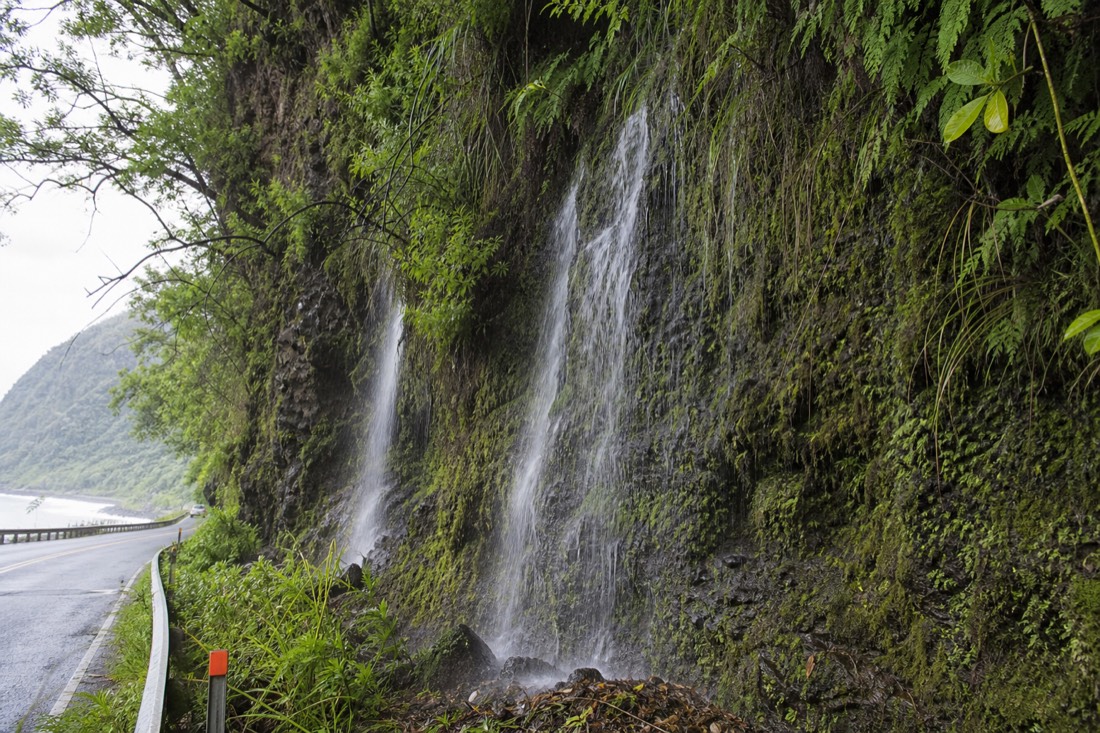
ʻAkaka Falls, without hesitation, unless your day is genuinely under two hours or stairs are impossible. It is the tallest, the most dramatic, and the only one that feels like an event rather than a stop. Rainbow Falls is the right answer only when time or mobility rules the other out.
I give this recommendation several times a week and it is never close. A 442-foot free fall into a fern gorge, reached by a short paved loop through bamboo and heliconia, is a genuinely world-class thing to see and it takes under an hour. Nothing else within an hour of Hilo is in that category. The is it worth it page makes the same argument at greater length and with the counter-arguments included.
Rainbow Falls wins on exactly two axes. It is faster, since you can be parked, at the rail and back in the car inside twenty minutes. And it is easier, with no meaningful walking and no stairs. For a cruise passenger with a tight all-aboard time, or a visitor whose knees have opinions, those two axes decide it, and there is no shame in that answer.
For anyone with a full day and a taste for doing it properly, the combination beats either alone, and a guided day that takes in the falls, Rainbow Falls and the volcano together covers all of this coast's headline water plus the thing that made the island in the first place, without you working out parking at any of them.
If the coast itself is calling more than the falls, the drive keeps giving north of the park, and the Waipiʻo Valley and Hamakua Coast guide picks up where this morning ends. Five falls, one morning, no invented numbers. That is the whole promise of this page, and it is the only promise about Hawaiian waterfalls I am willing to make in writing.
Half day
from $229.99per person, varies by date Check availability →About 2.5 hours
from $246per person, varies by date Check availability →Half day
from $150per person, varies by date Check availability →