Akaka Falls, Volcanoes & Rainbow Falls day
Full day
from $188per person, varies by date Check availability →One is an 80-foot roadside classic in town, the other a 442-foot giant up the coast. The right answer is not either-or.
 Verified by Kekoa Kalani, Akaka Falls tour guide and island nature specialist
Short answer
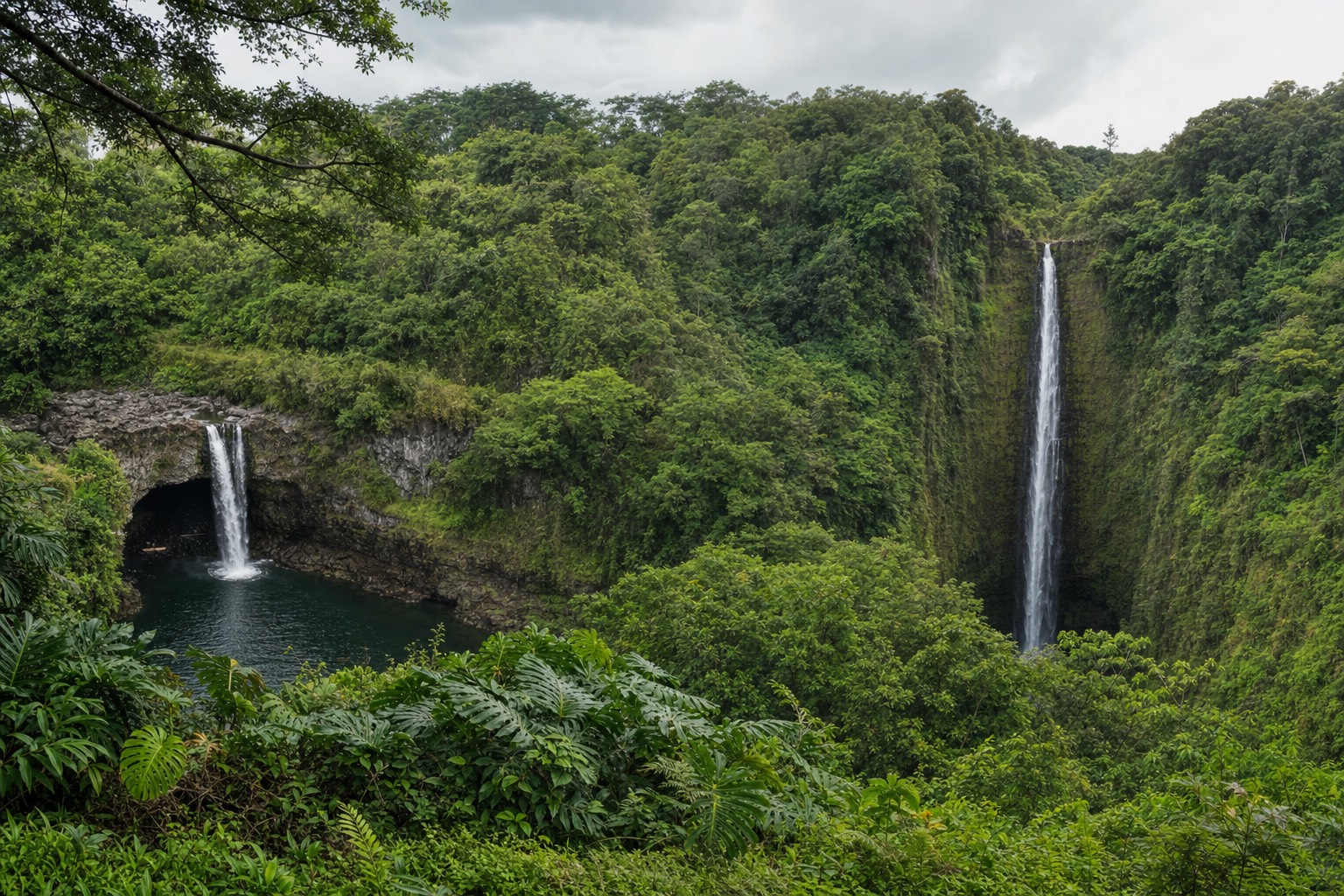
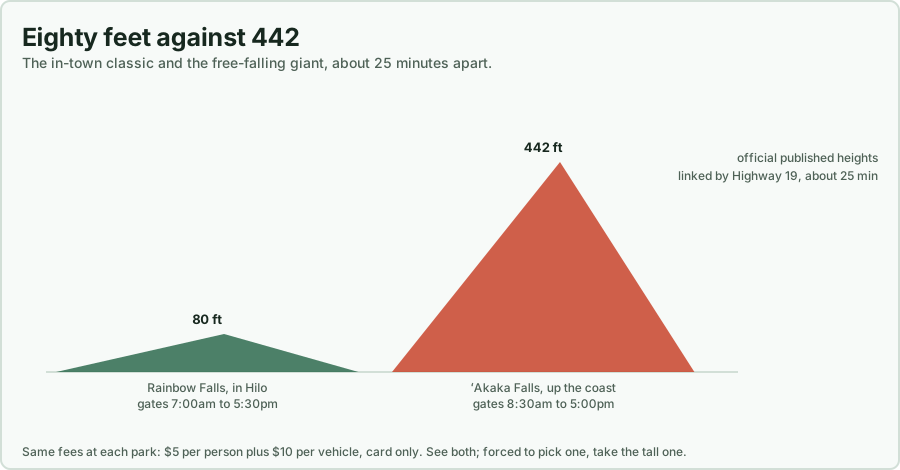
See both. Rainbow Falls is an 80-foot drop minutes from downtown Hilo with a near-roadside view, and ʻAkaka Falls is the taller, more dramatic 442-foot fall about 25 minutes up the coast. Most Hilo waterfall itineraries cover both in one morning. Forced to choose one, choose ʻAkaka.
The first time a guest asked me to settle this, we were standing on the Rainbow Falls terrace at twenty past nine with the Wailuku River loud underneath us and a thin arc of color sitting in the spray. She had ʻAkaka Falls circled on her map for the afternoon and wanted to know whether it was worth the drive, or whether she was looking at the same thing already. I pointed north past the ironwoods and gave her the short version: this one is 80 feet, the one you circled is 442. Then I gave her the rest of it, which is that the two parks sit about twenty-five minutes apart, and the question she was asking almost never needs answering. She did both before lunch and still made her afternoon.
ʻAkaka Falls is the bigger and more dramatic waterfall, free-falling 442 feet into a stream-eroded gorge about 11 miles north of Hilo. Rainbow Falls is an 80-foot drop over a lava cave minutes from downtown, with the viewpoint close to the car park. Both now charge identical state-park fees.
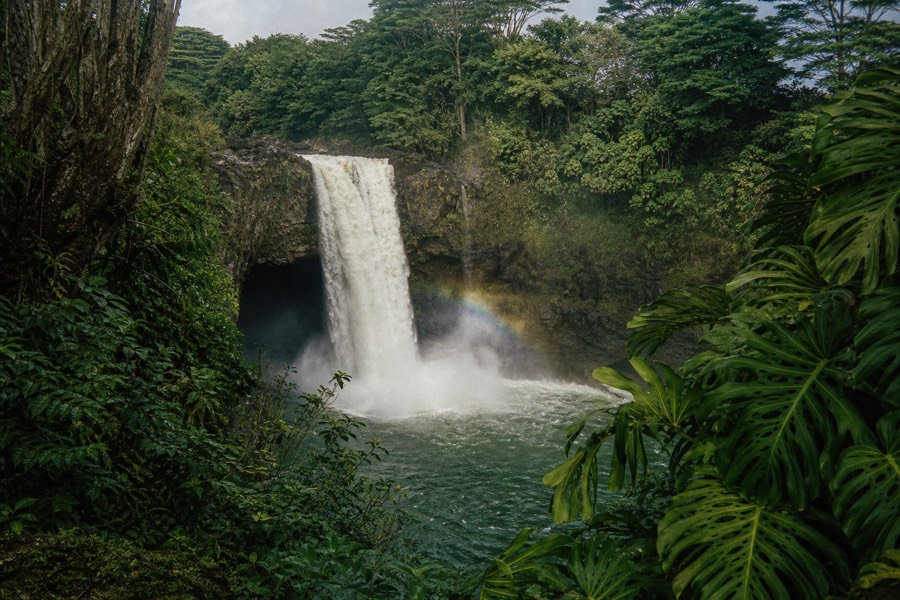
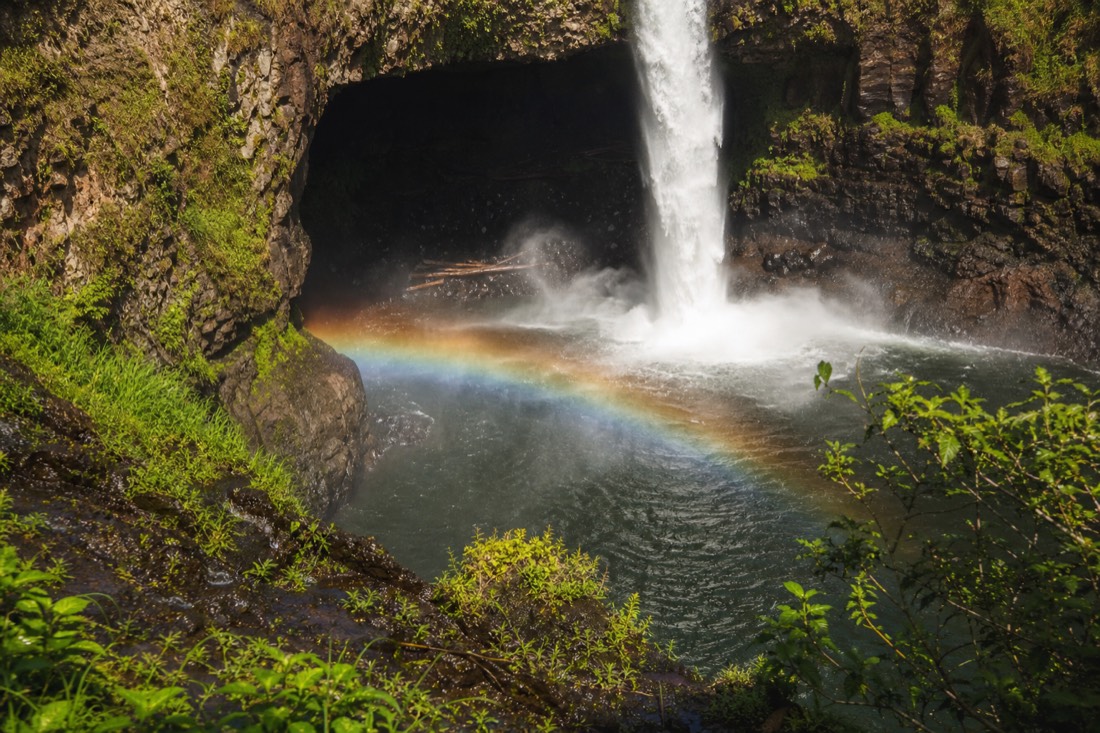
Better is the wrong frame, but if you force me into it, ʻAkaka wins on spectacle by a distance you can measure. Five and a half Rainbow Falls stacked on top of each other still would not reach the lip of ʻAkaka. What Rainbow Falls has instead is proximity and a trick nothing else on this island does reliably: on clear mornings the sun cuts into its own mist and hangs a rainbow in front of the water.
Rainbow Falls sits inside Wailuku River State Park, a compact 16.3-acre park split into two separate areas along the river. The falls itself is off Rainbow Drive; Boiling Pots is at the end of Peʻepeʻe Falls Drive, and both are reached from Waiānuenue Avenue in downtown Hilo. ʻAkaka Falls State Park is four times the size at 65.4 acres and sits at the end of Highway 220, above the old sugar town of Honomū, on the Hamakua Coast.
The practical difference nobody puts in a comparison chart is what each stop costs you in time. Rainbow Falls is a fifteen-minute stop that feels complete. ʻAkaka is a forty-minute walk minimum if you want to enjoy it, and an hour if you stand still and actually look. That is the real trade, not the height. Here is the honest side-by-side.
| Rainbow Falls | ʻAkaka Falls | |
|---|---|---|
| Height | 80 feet | 442 feet, free-falling |
| Park | Wailuku River State Park, 16.3 acres | ʻAkaka Falls State Park, 65.4 acres |
| Where | Off Waiānuenue Avenue, downtown Hilo | End of Highway 220, about 11 miles north of Hilo |
| The walk | Short; the viewpoint sits near the parking area | 0.4-mile paved loop with stair sections |
| Hours | Daily 7:00am to 5:30pm, gates lock at 6:00pm | Daily 8:30am to 5:00pm |
| Entry | $5 per person, $10 per vehicle, card only, residents free | $5 per person, $10 per vehicle, card only, residents free |
| Bonus sight | Boiling Pots, covered by the same fee | Kahuna Falls, on the same loop |
| Swimming | No; no lifeguards, and neither area is safe for it | No; the loop is a fenced viewing trail above a closed gorge |
| Signature moment | Morning rainbows in the mist | The sheer scale of the drop from the overlook |
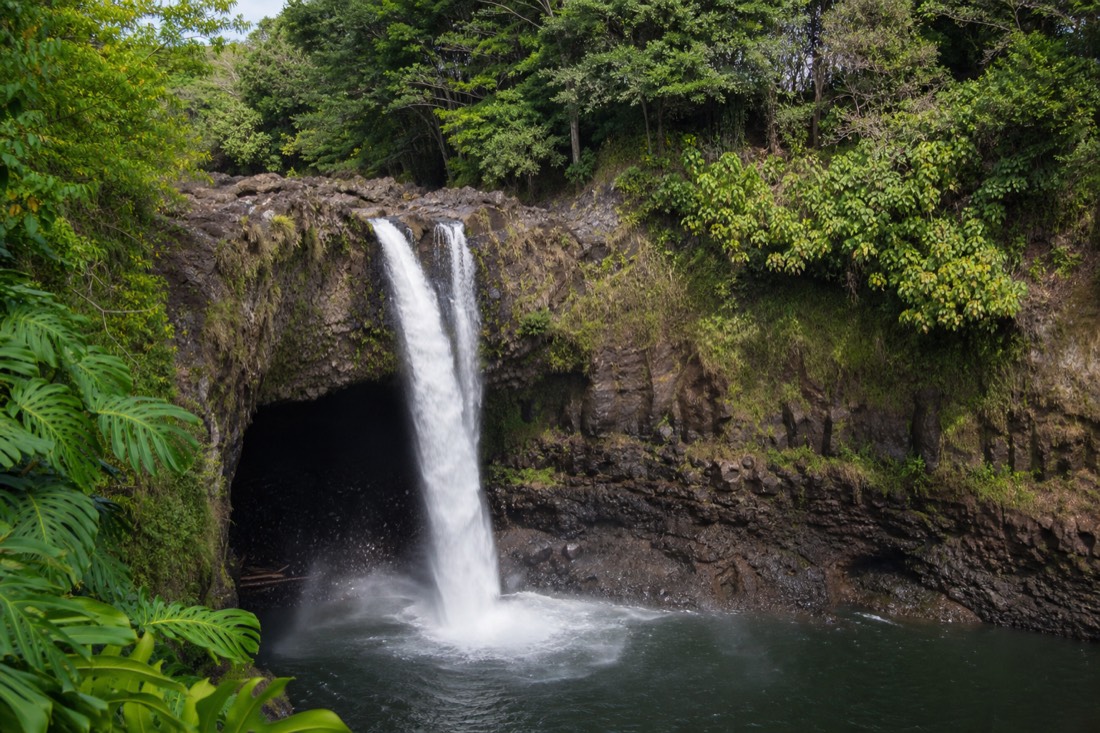
Rainbow Falls is a wide, powerful 80-foot curtain pouring over the roof of a lava cave into a pool at river level, so you view it almost head-on. ʻAkaka Falls is a narrow 442-foot free fall down a wall of a stream-cut gorge, seen from above, which makes it a vertical scene rather than a horizontal one.
Once you see the geology, you stop comparing them at all. At Rainbow Falls the Wailuku River runs across a shelf of old lava and drops off the front of it. The cave underneath is the whole point of the place: the water shoots over an open mouth in the rock, and the volume of spray thrown back up is what makes the rainbow possible. It is a broad, muscular waterfall. After a wet night it can go brown and furious and fill the whole basin with noise. In a dry spell it thins into two or three separate ropes of water, which is a different photograph but not a lesser one.
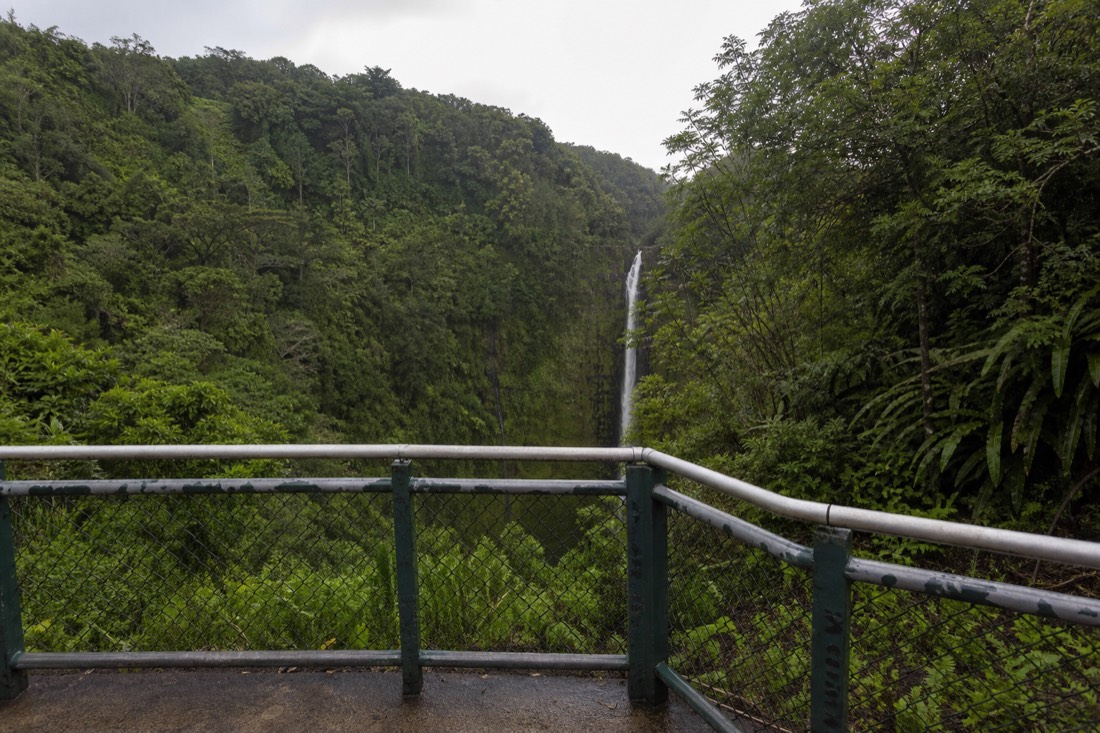
ʻAkaka does something else entirely. Kolekole Stream reaches the head of a gorge it has been cutting for a very long time and simply leaves the rock, falling 442 feet without touching anything. There is no shelf, no staircase of cascades, no braiding. From the overlook you are looking across and down into a green amphitheatre, and the water is a single white line against dark basalt and ferns. The scale takes a moment to land. People routinely underestimate it because there is nothing familiar in the frame for size, no railing at the base, no person, no tree you recognise.
Volume behaves differently too. Rainbow Falls responds to rain within hours because its catchment sits right above town. ʻAkaka is fed by the wet uplands of Mauna Kea's flank and runs hard essentially year-round, which is why it never disappoints on a dry visit. If you have only ever seen one of them in photos, understand that they are not two versions of the same thing. One is horizontal drama at your eye level. The other is vertical drama below your feet.
Rainbow Falls is one of the easiest waterfall stops in Hawaii: park off Rainbow Drive and the overlook is a short level walk away, no stairs needed. ʻAkaka Falls asks for a 0.4-mile paved loop with several flights of steps, officially described as requiring some physical exertion and not wheelchair accessible.
The gap in effort is bigger than the gap in distance suggests. At Rainbow Falls you get out of the car, walk a paved path past a huge banyan, and the falls is in front of you inside two minutes. There are higher viewpoints up a short set of steps if you want the view over the top of the falls, but nobody has to take them. I have brought guests straight from the airport with rolling luggage still in the van and had them at the rail before they finished stretching.
ʻAkaka is a real, if short, trail. The state describes the loop honestly: a 0.4-mile paved footpath with multiple steps in places, requiring some exertion, not wheelchair accessible. Taken clockwise you get the long climb on the way back; taken the other way you get it early. There is a shortcut worth knowing, and I use it with slower groups all the time: from the first junction take the left, southern path and you reach the main overlook without doing the full circuit. You lose Kahuna Falls and you keep your knees. I break down every step of the circuit, including that shortcut and who should take it, in the trail guide.
Weather changes the difficulty at ʻAkaka in a way it never does at Rainbow Falls. The pavement gets slick under the canopy and stays wet for hours after a shower. Grip matters more than fitness. Here is the comparison I actually give people at the van door.
| Access factor | Rainbow Falls | ʻAkaka Falls |
|---|---|---|
| Parking | Small lot off Rainbow Drive, minutes from downtown Hilo | Lot at the end of Highway 220, above Honomū |
| Distance to the first view | A short level walk from the car | A few hundred feet to the first junction, then the loop |
| Surface | Paved terrace and short paths | Paved footpath the whole way, often wet |
| Stairs | None needed for the main view | Several flights, unavoidable on the full circuit |
| Accessibility | Officially described as easily accessible | Officially not wheelchair accessible |
| Time on foot | 10 to 15 minutes | 30 to 45 minutes for the loop, less via the south path |
| Who it suits | Anyone, including very short stops and tired legs | Anyone comfortable on steps and a damp slope |
Both parks charge the same. Non-residents pay $5 per person plus $10 per vehicle, credit card only, with Hawaii residents free on ID and children 3 and under free. Commercial vehicles pay $25, $50 or $90 by size. At Wailuku River, one payment covers Rainbow Falls and Boiling Pots.
This is the single most out-of-date fact on the internet about Hilo. For years Rainbow Falls was the free waterfall, the one you told people to stop at because it cost nothing, and half the travel blogs still say so. As of January 2026 the state charges entrance and parking fees at Wailuku River State Park on exactly the schedule ʻAkaka has used. Turn up expecting free and you will be fine, you will just be paying, and you will need a card because neither park takes cash.
The one genuinely good piece of news is that your Wailuku River payment spans both sections of that park. Rainbow Falls and Boiling Pots are two separate areas with two separate access roads, but one fee. Driving the extra two minutes up to Boiling Pots after the falls adds nothing to the bill, which quietly makes Wailuku River the better value of the two parks per dollar.
Pay before you arrive if you can. Cell reception is thin at ʻAkaka in particular, and I have watched people stand in the lot waving a phone at the sky while their group waited. The state's booking site handles both parks. Below is the real arithmetic for two adults sharing one rental car doing the classic two-waterfall morning, and the full picture including guided days is in the cost breakdown.
| What you pay | Wailuku River State Park | ʻAkaka Falls State Park |
|---|---|---|
| Non-resident entry | $5 per person | $5 per person |
| Non-resident parking | $10 per vehicle | $10 per vehicle |
| Hawaii residents | Free with state ID | Free with state ID |
| Children 3 and under | Free | Free |
| Commercial vehicles | $25, $50 or $90 by size | $25, $50 or $90 by size |
| Payment method | Credit card only | Credit card only |
| What the one fee covers | Rainbow Falls and Boiling Pots | ʻAkaka Falls and Kahuna Falls on the loop |
| Two adults, one car | $20 | $20 |
| Running total for the morning | $20 | $40 |
Forty dollars for a couple to see three named waterfalls, the Boiling Pots and a rainforest gorge before lunch. It is no longer the free morning it used to be, but measured against almost anything else you can do on a resort island, it is still small money for a very large day.
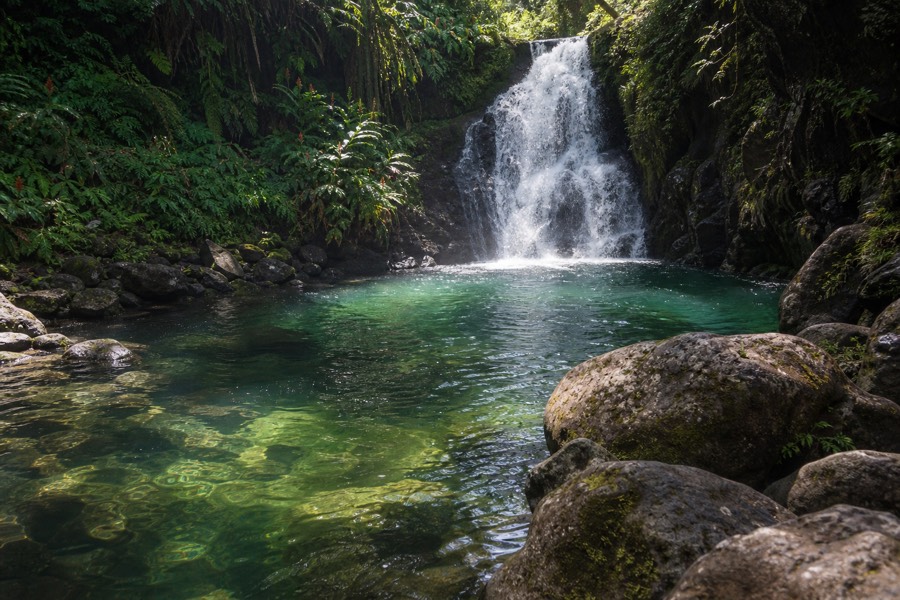
Wailuku River State Park adds Boiling Pots, a chain of large pools linked by underground flow and cascades, lined with exposed hexagonal basalt columns, plus Peʻepeʻe Falls upstream. ʻAkaka Falls State Park adds Kahuna Falls on the same loop and a bamboo and fern corridor that is a scene in its own right.
Boiling Pots is the most skipped good thing in Hilo. Almost nobody who stops at Rainbow Falls drives the extra couple of minutes to the end of Peʻepeʻe Falls Drive, which is a shame, because it is the more unusual geology of the two. The Wailuku River here runs through a succession of big round pools connected partly by surface cascades and partly by flow moving underneath the rock, so on a high-water day the pools appear to churn and boil from below with no visible source. That is where the name comes from.
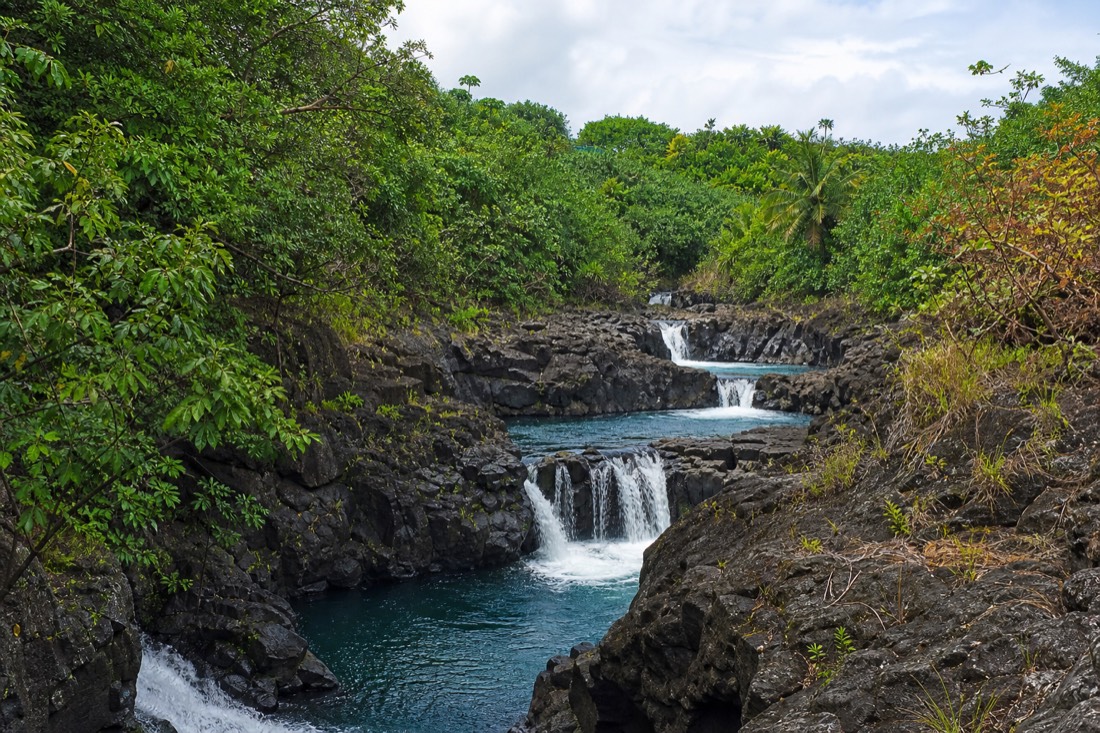
The rock around those pools is the other reason to go. Slow-cooled lava fractured into hexagonal columns, and the river has stripped them bare, so you are looking at textbook basalt geometry from a viewpoint that took you four minutes to reach. Upstream from the same overlook you can see Peʻepeʻe Falls when the light and water level cooperate. Three separate water features, one fee, and most visitors see one of them.
ʻAkaka's extras are softer but no less real. Kahuna Falls sits on the northern arm of the loop, a cascading fall in a green fold of the gorge, and it is the reason to walk the full circuit rather than take the south shortcut. The loop itself passes through planted rainforest: bamboo that clatters when the trade wind moves, tree ferns, wild ginger, heliconia. On a wet morning the smell alone justifies the walk. If you want the wider circuit of what else runs on this side of the island, the waterfalls near Hilo roundup covers the rest.
| Extra sight | Which park | What it is | What it adds to your visit |
|---|---|---|---|
| Boiling Pots | Wailuku River | Large pools linked by underground flow and cascades | Unusual river geology, four minutes from Rainbow Falls, no extra fee |
| Hexagonal basalt columns | Wailuku River | Exposed columns formed by slow-cooled lava | The clearest columnar basalt you can see without a hike |
| Peʻepeʻe Falls | Wailuku River | Falls upstream of the Boiling Pots viewpoint | A third named waterfall on the same stop |
| Kahuna Falls | ʻAkaka Falls | Cascading falls on the northern arm of the loop | The payoff for walking the full circuit |
| The bamboo corridor | ʻAkaka Falls | Planted rainforest of bamboo, tree ferns and ginger | Turns a viewpoint into a walk worth doing slowly |
Waiānuenue, the Hawaiian name for Rainbow Falls, means rainbow water, and tradition holds that the cave beneath the falls was the home of Hina, mother of the demigod Māui. ʻAkaka carries its own account, tied to the name and to the song that made the falls famous far beyond Hawaii.
Names on this island are rarely decorative. Waiānuenue describes exactly what the place does on a clear morning: water that makes a rainbow. The avenue you drive in on carries the same name, which is a small clue that the falls was never a tourist discovery but a landmark people had oriented themselves by for a very long time.
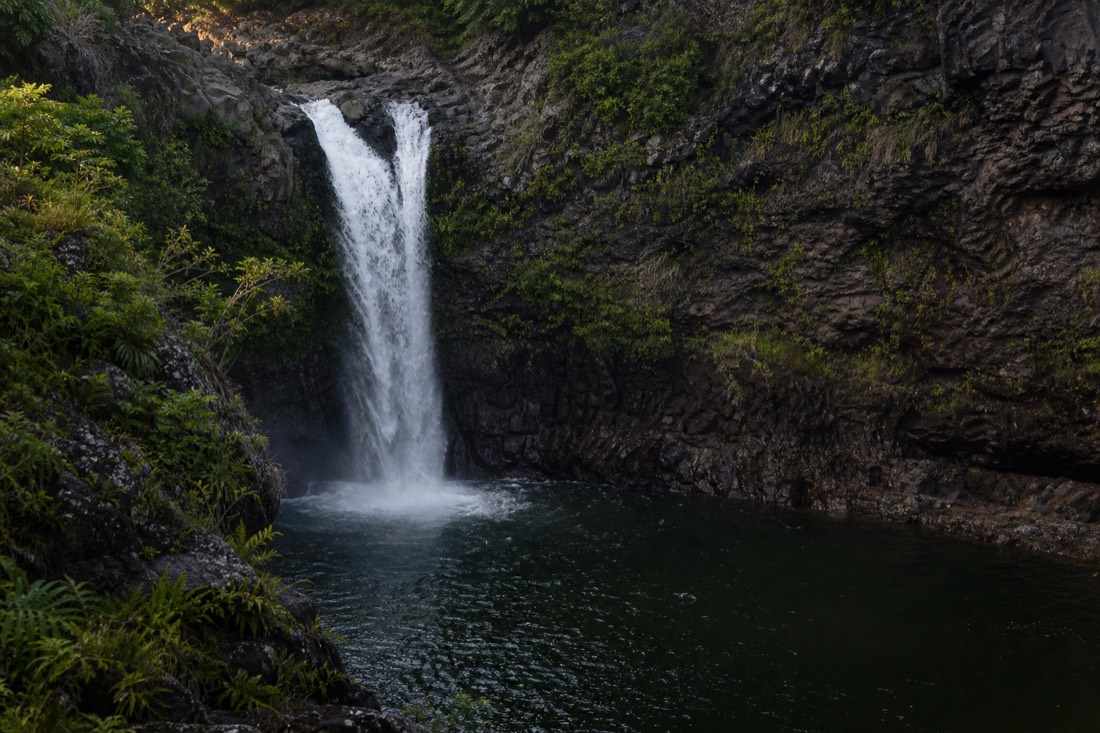
The cave under the falls is the part guests remember. In the tradition, it was the dwelling of Hina, and she is not a minor figure: she is the mother of Māui, the demigod whose exploits run through the whole Pacific. Stand at the rail and look at where the water leaves the lip, and you are looking at the roof of that cave. I do not dress the story up beyond what it is, and I do not send anyone down toward the water to look for the entrance. It is a story about a place, told at the place, and it lands better plain.
ʻAkaka's story is longer and I give it the room it deserves in the legend and the song, including how a piece of music turned a waterfall on a plantation road into something people in Honolulu could hum. What matters for the comparison is that neither of these waterfalls is a scenic pull-off with a name attached later. Both were embedded in how people here understood the land, one as a doorway in the rock at the edge of town, the other as a drop at the head of a gorge nobody could climb. Knowing that changes what a fifteen-minute stop feels like, which is roughly the entire reason I bother telling it.
Rainbow Falls opens at 7:00am and peaks around 10:00am on sunny mornings, when the sun angles into the mist and the rainbow appears. ʻAkaka opens at 8:30am and is quietest in its first ninety minutes. The two schedules complement each other, which is why the town-first routing works so cleanly.
The rainbow is not a marketing line. It is a repeatable optical event that needs three things at once: water in the air, direct sun, and you standing between the two at the right angle. Morning does that. By early afternoon the sun has moved off the useful angle and the show is over regardless of how good the weather is. On the rainy side of the island you will not get it every day, and anyone who promises you otherwise has not spent a February here.
ʻAkaka's rhythm is about people rather than light. The first vans of the day tend to reach the lot mid-morning, so the window between opening and roughly ten o'clock is the calm one. After that the small lot fills and empties in waves, and by midday you are sharing the overlook. Late afternoon thins out again but the gorge falls into shade early, which some people love and photographers argue about. The full seasonal and daily timing guide goes deeper on months and rainfall.
Stop length is the variable most visitors get wrong. A twenty-minute coach stop at ʻAkaka is enough to see the waterfall and nothing else, and people come away wondering what the fuss was. If you would rather be on the coast side with a proper hour there instead of a hurried lap, the Hilo day that budgets a full hour at the falls is the one I point at, because time at the rail is what turns this from a photo stop into a memory.
| Time window | Rainbow Falls | ʻAkaka Falls |
|---|---|---|
| 7:00 to 8:00am | Gates open, empty terrace, soft light, no rainbow yet | Closed until 8:30 |
| 8:30 to 10:00am | Sun climbing into the mist, building toward the arc | The quietest ninety minutes of the day |
| Around 10:00am | The rainbow window on clear mornings | First wave of vans arrives |
| Midday | Harsh overhead light, busiest hour | Busiest, and hard contrast between gorge and sky |
| Early afternoon | Rainbow gone, water still impressive | Crowds easing, gorge starting to shade |
| Closing hours | Out by 5:30pm, gates lock at 6:00pm | Park closes at 5:00pm |
Rainbow Falls is a timing problem: you need direct morning sun on the mist, and the arc comes and goes within minutes. ʻAkaka is a scale and light problem, shot from fixed railing positions into a shaded gorge with mist drifting up and a very bright sky above the rim.
At Rainbow Falls you have options and you have a deadline. There are viewpoints at the main terrace and above the falls, so you can move to chase the angle, and the whole scene is close enough that a normal wide lens covers it. Bring something to wipe the lens, because on a strong-flow day the spray reaches you. The arc appears when the geometry lines up and it can vanish while you are changing settings, so shoot first and refine after. The forgiving part: it is genuinely repeatable. If today is grey, tomorrow morning might not be.
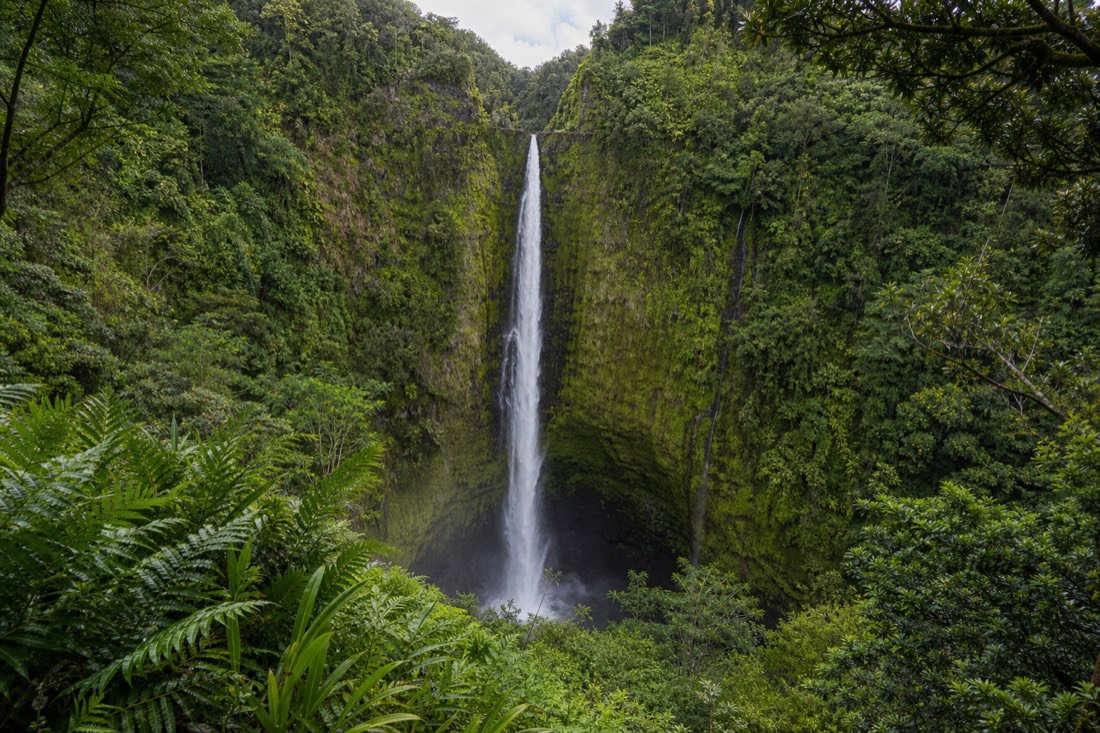
ʻAkaka gives you almost no positional freedom and a much harder exposure. The overlook is fenced, the angles are fixed, and the falls is far enough away that a phone at default zoom renders it as a thin white thread with no drama at all. The honest fix is to include something for scale, a fern crown or a section of gorge wall in the near frame, so the eye understands the distance. Overcast is your friend here: it flattens the range between the bright sky over the rim and the dark rock below.
Neither one rewards rushing. I have watched people take four seconds of phone video at ʻAkaka and walk back to the lot, and I would rather they stood there for ten minutes and took nothing. The photography guide has the settings and the exact spots; here is the quick comparison.
| Rainbow Falls | ʻAkaka Falls | |
|---|---|---|
| The subject | An 80-foot curtain plus an arc that comes and goes | A 442-foot ribbon in a deep, shaded gorge |
| Light you want | Direct morning sun striking the mist | Even overcast, or the shaded middle of the day |
| Main difficulty | Timing; the rainbow is brief and conditional | Scale, distance and heavy contrast |
| Your position | Terrace plus higher viewpoints, several angles | Fixed railing spots on the loop, no alternatives |
| Worth carrying | Wide lens and a cloth for the spray | Wide lens, cloth, steady hands for low light |
| Repeatable? | Yes, come back the next clear morning | The water always runs; the light is the variable |
ʻAkaka, without much hesitation. It is more than five times taller, it runs hard year-round, and it is the one people describe months later. Rainbow Falls needs sun to do its trick, and on a grey Hilo morning it is a good waterfall rather than an unforgettable one.
The genuine either-or cases are rarer than the search results suggest. I can think of two. The first is a cruise passenger with a tight shore window who has to be back at the terminal by a hard deadline and wants one real stop rather than two rushed ones. The second is a Kona-side driver heading over for a volcano day who can spare exactly one waterfall on the way. In both cases my answer is the same, and I have not changed it in years.
Why ʻAkaka: because it is the one that produces the reaction. Rainbow Falls delights people. ʻAkaka silences them for a second, and that second is what you drove for. There is also a reliability argument. ʻAkaka is fed from the wet uplands and looks powerful in any weather; Rainbow Falls at its very best needs a clear sky at a specific hour, and Hilo does not hand those out on demand. Betting your one stop on weather you cannot control is bad planning.
If you are coming from a ship, the port logistics and timings are laid out in the cruise-port guide. If you are driving over from the resort coast, the honest drive time and the fuel-and-hours reality are in the Kona route guide. For that second case, the one where the whole trip is a long day out of Kona, the waterfall day that starts on the resort side removes the part people underestimate, which is driving the Saddle or the coast road twice in one day on your own energy.
There is one situation where I flip the answer, and it is the stairs. If someone in your party cannot manage several flights of wet steps, ʻAkaka becomes a compromise even using the south shortcut, and Rainbow Falls gives them a full waterfall with no climb at all. Dignity beats height. Here is how I answer the question by situation rather than in the abstract.
| Your situation | What I would do | Why |
|---|---|---|
| Cruise day, hard all-aboard time | ʻAkaka only, straight out and back | One unhurried stop beats two rushed ones, and it is the memorable one |
| One free morning based in Kona | ʻAkaka, or hand the driving to someone else | The round trip is long; a half-seen waterfall is a wasted drive |
| A full day based in Hilo | Both, town first, Boiling Pots included | The whole circuit fits before lunch with time to spare |
| Someone in the group cannot do stairs | Rainbow Falls, and Boiling Pots after it | Level access, no steps needed, three water features on one fee |
| Grey, rainy morning | ʻAkaka first, Rainbow Falls on the way back | Rain never hurts ʻAkaka; the rainbow needs sun that may still arrive |
| Travelling with small children | Rainbow Falls first to bank a win, then decide | Short, immediate, no negotiation required about walking |
Start in town. Rainbow Falls opens at 7:00am, so take it first, add Boiling Pots on the same fee, then drive about 25 minutes north on Highway 19 and Highway 220 to ʻAkaka, which opens at 8:30am. Coffee in Honomū sits between the two. Both done well before noon.
The routing writes itself because the opening hours are staggered in your favour. Be at Rainbow Falls around half seven and you will have the terrace close to yourself in soft light. Give it fifteen minutes, then drive up to Boiling Pots for another fifteen, remembering you already paid for it. By quarter past eight you are back on Waiānuenue Avenue heading for the highway.
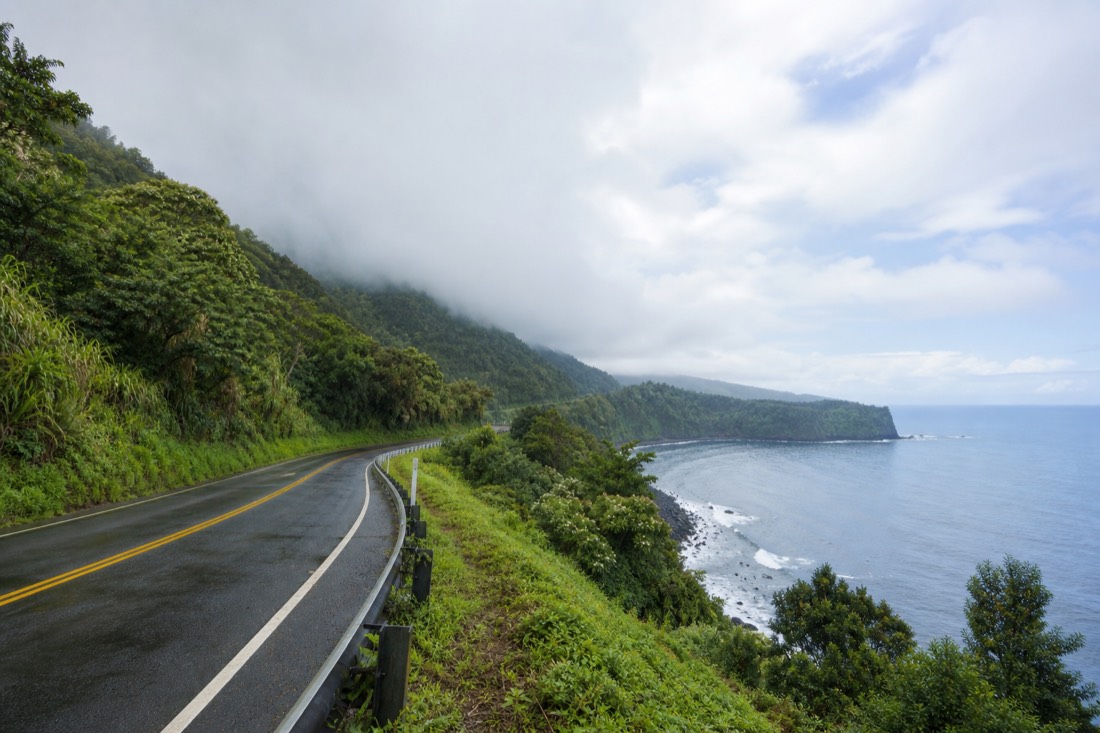
The drive north is not dead time. Highway 19 runs the Hamakua Coast past gulches and old plantation land, and if you have twenty minutes to spare the Onomea scenic drive loops off it and back. Reach the ʻAkaka lot around nine or half past and you are inside the quiet window, ahead of the mid-morning vans, with mist still lifting off the gorge. Take the loop slowly, do the full circuit for Kahuna Falls if legs allow, and you are back at the car by ten thirty. Honomū is four minutes downhill for coffee and banana bread. The complete version of this itinerary, afternoon included, is the perfect day plan.
One flip to keep in your pocket. If you wake up to grey, reverse it: drive to ʻAkaka first, because rain never hurts it and often improves it, then catch Rainbow Falls on the way back into town around ten in case the sky has opened. I wrote about what a wet morning actually looks like out here in rain at the falls. If you would rather not drive any of it, the Hilo day that adds Rainbow Falls and the Onomea drive follows almost exactly this sequence, which makes it the natural pick when seeing both waterfalls is the point of your day.
No, at both. Wailuku River State Park has no lifeguards and neither the Rainbow Falls pool nor Boiling Pots is safe for swimming, and people have died in that river. ʻAkaka's loop is a fenced viewing trail above a gorge with no water access at all. The swimming happens elsewhere.
I am blunt about this because the Wailuku is genuinely dangerous and it does not look it. The pools at Boiling Pots are beautiful, warm-looking, apparently calm. Underneath, water is moving between them through the rock at speed you cannot see from the bank, and the river rises fast when it rains upstream, sometimes with no rain falling where you are standing. There are no lifeguards at either area. The state does not frame this as a swimming park, and the local record of what happens when visitors treat it as one is not a story I enjoy telling at the rail.
ʻAkaka removes the temptation by design. The loop is a viewing trail; the gorge below is closed off and there is no route down to the plunge pool. That fence is not there to spoil anyone's fun. A 442-foot free fall lands with force, into water full of debris the stream has been carrying since the last storm.
So where can you actually get in? The Big Island does have swimmable waterfalls, and the difference is that they come with someone who knows the water. A guided hike with a Native Hawaiian guide to a fall you can swim under is the honest answer to the question this section asks, and if that is what you pictured when you started planning, that half day is the one to look at rather than trying to improvise access somewhere you should not be. I go through the whole subject, including the places people wrongly assume are open, in can you swim at ʻAkaka Falls.
Most Hilo-pickup waterfall itineraries take in both, because town falls first and coast falls second is simply the shape of the local circuit, and park admissions are included in the ticket. Stop lengths vary a lot by operator, so read the itinerary for your date rather than assuming.
Drive around Hilo often enough and you learn the rhythm of the vans. They do Rainbow Falls early while the light is soft and the lot is empty, then run north up the coast to ʻAkaka before the mid-morning crush, then either turn inland for the volcano or back into town. Nobody invented that order for marketing reasons; the geography and the opening hours allow nothing smarter, which is exactly the sequence I recommended above for drivers.
What actually separates the options is time on the ground. Two operators can both list ʻAkaka and give you wildly different visits, one a twenty-minute lap and the other a full hour with room to walk the circuit properly. Aloha Aina runs the two Hilo-side days I know best, and they are the same operator selling two slightly different routings: one built around the longest single stop at the falls, the other adding Rainbow Falls and the Onomea scenic drive to the day. For an article about seeing both waterfalls, the second is the obvious fit. Both include the park entries, which quietly cancels out the fees discussed earlier.
The other thing worth checking is pickup side. A Hilo-pickup day is the wrong ticket if you are sleeping in Waikoloa, and a Kona circle day will give you a shorter falls stop because it is covering far more ground. My rule of thumb: match the tour to the side of the island you wake up on, then compare stop lengths, then look at the date. The Hilo departures and Kona departures are grouped that way for exactly this reason, and how much time you need at the falls explains what a stop length actually buys you.
So stop weighing them against each other. Rainbow Falls is the opening act five minutes from town, ʻAkaka is the headliner up the coast, and the morning that holds both, with Boiling Pots and Honomū in between, is the best two hours of sightseeing on this side of the island. The only wrong answer to which one is treating it as a real question.
Full day
from $188per person, varies by date Check availability →7 to 8 hours
from $179per person, varies by date Check availability →Half day
from $150per person, varies by date Check availability →